


For $10 a month, or $100 a year, you support a simple mission: spread great data visualisation wherever it comes from. You help fund the work of finding, sourcing and explaining the charts that deserve a wider audience. And you back a publication built on generosity, transparency and the belief that better understanding makes a better world.
For years now, the global economy has been narrated as if it were perpetually on the brink. Recession calls, stagnation fears and decline stories have dominated the conversation. Yet the data keeps telling a more complicated story.
Growth has not disappeared. It has shifted. It has slowed in some places, accelerated in others and changed its underlying shape in ways that many forecasts struggle to capture. What looks like weakness from one angle often turns out to be resilience from another.
CHART 1 • Why US growth keeps defying recession forecasts
For more than two years, predictions of an imminent US recession have dominated economic commentary. This chart helps explain why those calls have repeatedly missed the mark.
Quarterly growth has remained positive across most of the period, with only short lived slowdowns rather than a sustained contraction. Even as interest rates rose sharply, output continued to expand. More recent data and forward looking indicators now point to renewed acceleration rather than a clear loss of momentum.
The composition of growth matters. Unlike previous cycles, expansion has relied less on housing and consumer credit and more on business investment, government spending and services. Those components tend to be less sensitive to higher borrowing costs and unwind more slowly.
Labour markets have cooled, but employment has remained relatively firm. That has helped sustain household spending even as financial conditions tightened.
This does not mean the economy is risk free. It does suggest that the US growth engine has become more adaptable than many models assume.
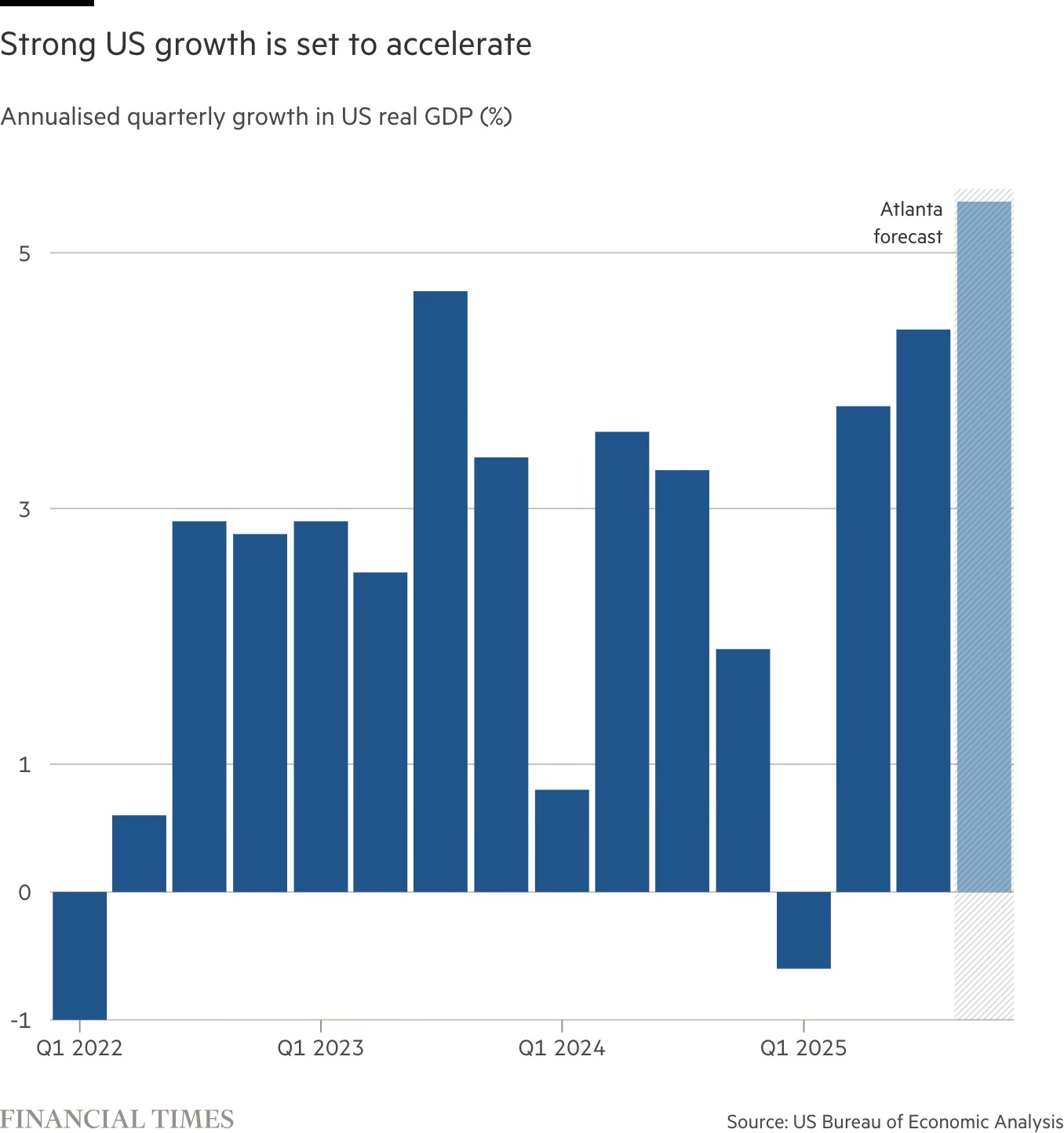
Source: Financial Times
One of the risks in macro analysis is mistaking familiarity for relevance. We keep reaching for old frameworks, even as the structure of growth quietly evolves underneath them. That gap between expectation and reality is where most forecasting errors live.
I have four more charts that deepen this story and add further context on where global momentum is really building. They are for paid subscribers. If you want the full edition and the thinking behind it, consider joining.
