


For $10 a month, or $100 a year, you support a simple mission: spread great data visualisation wherever it comes from. You help fund the work of finding, sourcing and explaining the charts that deserve a wider audience. And you back a publication built on generosity, transparency and the belief that better understanding makes a better world.CHART 1 • Why most of life on Earth is still unknown
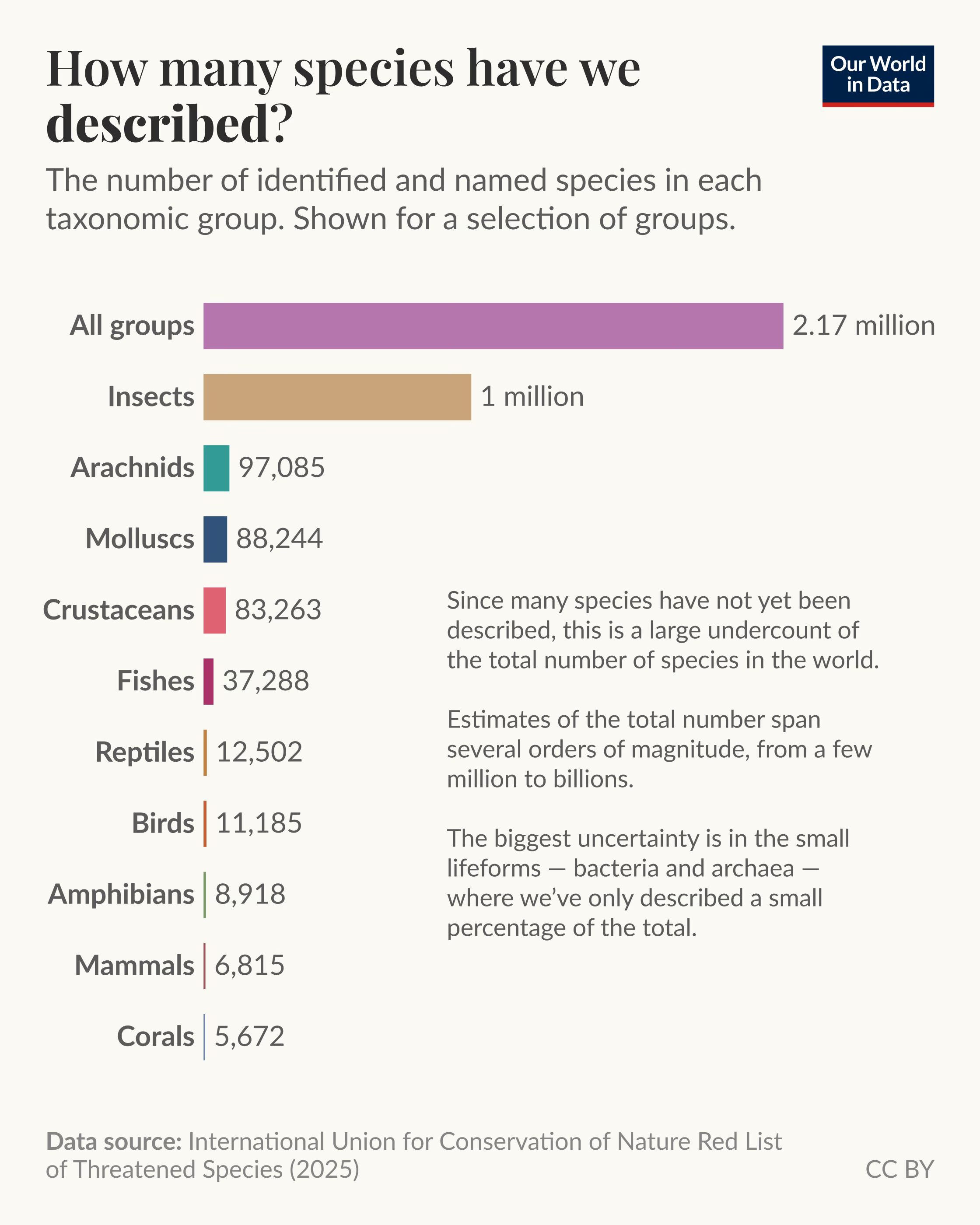
The striking number is not the 2.17 million species we have named. It is how little that likely represents. Scientists have catalogued about 1 million insects alone, but many estimates suggest total species could run into the tens of millions, especially once microbes are included. What we know is only a fragment of what exists.
That matters because discovery is uneven. Larger animals such as mammals and birds are mostly accounted for, which is why their numbers look small and stable. The vast unknown lies in smaller lifeforms, particularly insects, fungi and microscopic organisms, where new species are still being identified every year. In effect, biology has mapped the visible world but barely touched the hidden one.
The implication is humbling. Humanity has explored space, sequenced genomes and built artificial intelligence, yet much of life on our own planet remains undescribed. The chart is less a record of knowledge than a reminder of its limits, and of how much of Earth’s biodiversity is still waiting to be found.
Source: Our World in Data
The world is not simply becoming more open, more knowable or more disrupted. In many places, it is still shaped by deep structures that are hard to see and harder to change.
That should make us a little more humble. We have named only a fraction of life on Earth, misunderstood how elite networks work and repeatedly underestimated the staying power of incumbents. Progress is real, but so is inertia.
I’ve got four more charts that expand on this story, but they’re for paid subscribers. Consider joining if you want the full edition.
