

For $10 a month, or $100 a year, you support a simple mission: spread great data visualisation wherever it comes from. You help fund the work of finding, sourcing and explaining the charts that deserve a wider audience. And you back a publication built on generosity, transparency and the belief that better understanding makes a better world.CHART 1 • Why Hormuz matters far beyond oil
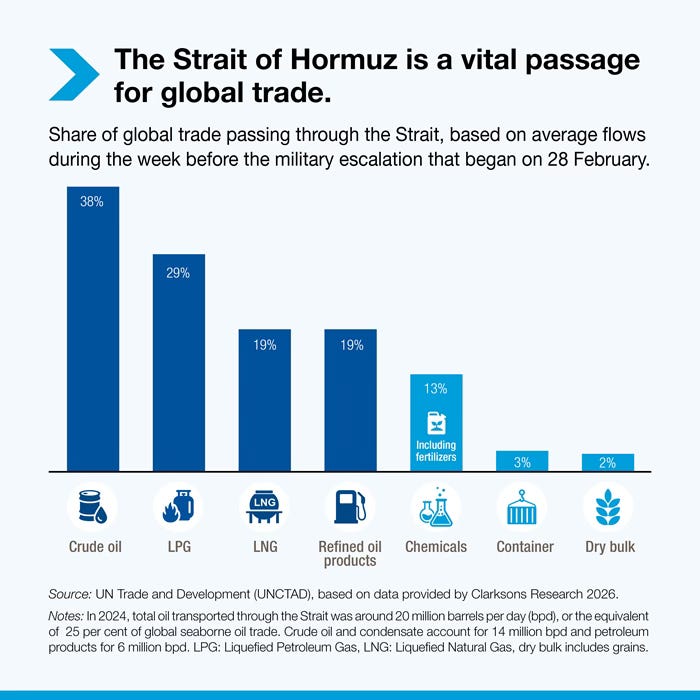
The Strait of Hormuz is usually discussed as an oil chokepoint, but this chart shows a broader vulnerability. Yes, crude dominates, but so do LPG, LNG and refined products. Add chemicals and fertilisers, and the story quickly becomes one about industry, food and inflation as well as energy. UN Trade and Development says the strait carried 38% of global seaborne crude oil trade, 29% of LPG, 19% of LNG, 19% of refined oil products and 13% of chemicals in the week before the latest military escalation.
That is why the disruption matters so much. Reuters has reported that the strait’s closure has put at risk roughly 20% of global oil and LNG flows, while UNCTAD says ship transits through Hormuz fell by 97% in early March compared with the February average. When a route that important seizes up, the problem does not stop at petrol prices. It moves into fertiliser, plastics, freight costs and eventually household bills.
Source: UN Trade & Development
What unsettles me about this set of charts is not simply the scale of the shock. It is how quickly the world rediscovers its dependencies. We like to talk as if the global economy has become more diversified, more flexible, more resilient. Then one strait tightens, one conflict escalates and the whole system starts reminding us how much still hangs on a few vulnerable routes and a few emergency buffers.
There is a wider lesson in that. Modern economies often look solid right up to the point where stress reveals what was quietly holding them together. Markets can absorb a great deal, but they cannot wish away physics, geography or war.
I’ve got four more charts that expand on this story, but they’re for paid subscribers. Consider joining if you want the full edition.
