

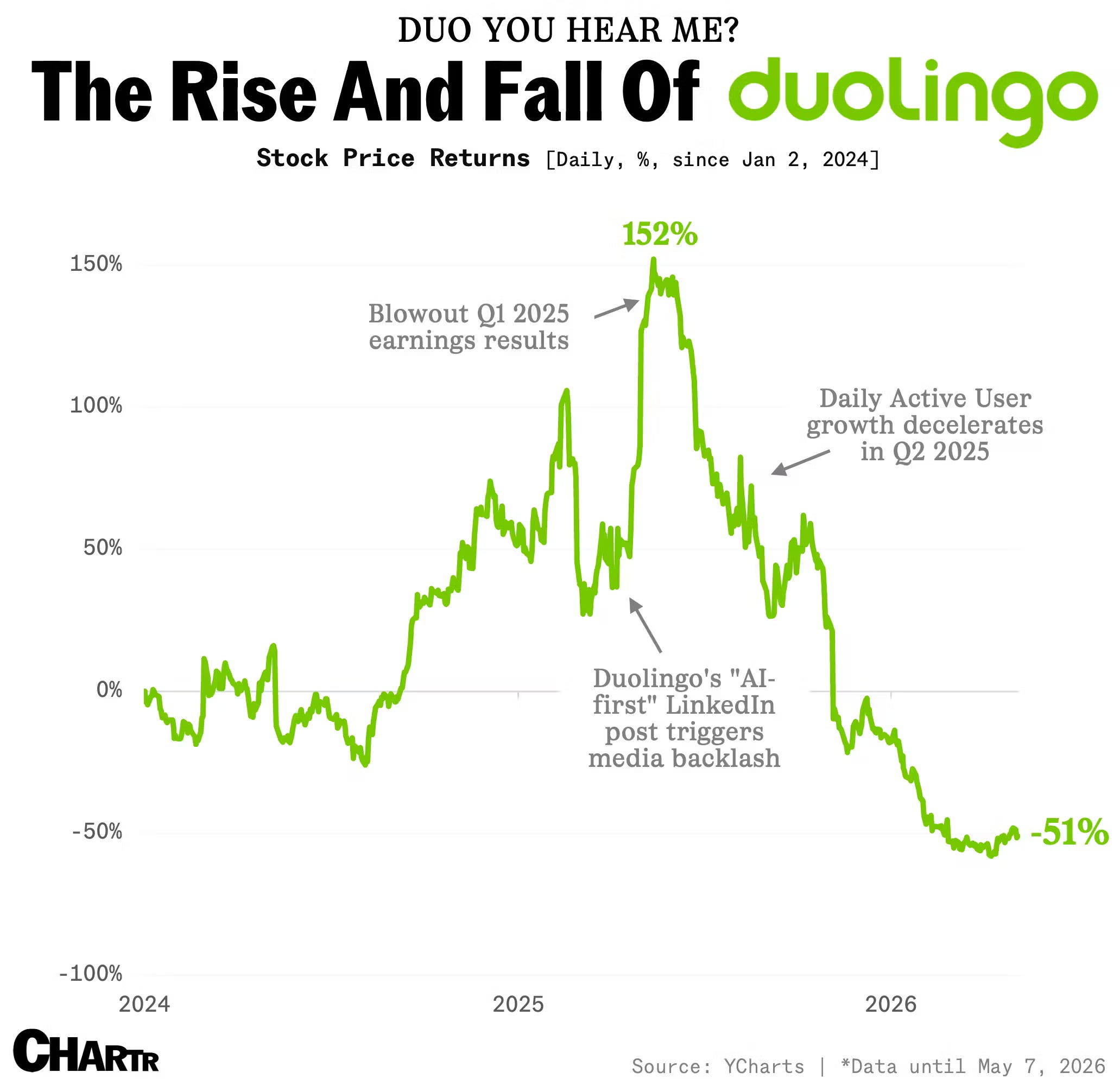
For $10 a month, or $100 a year, you support a simple mission: spread great data visualisation wherever it comes from. You help fund the work of finding, sourcing and explaining the charts that deserve a wider audience. And you back a publication built on generosity, transparency and the belief that better understanding makes a better world.CHART 1 • Why Duolingo stock lost its halo
Duolingo’s collapse is not really about one clumsy AI memo. It is about the moment investors stopped treating the company as a frictionless growth machine and started asking how long language learning can keep compounding at pandemic-era speed.
The irony is that the business is still performing. In early 2025, revenue was growing fast, daily active users were up 50% and the stock hit an all time high, but by 2026 Duolingo itself was warning that user growth had decelerated.
The AI backlash mattered because it turned a valuation problem into a trust problem. For consumer apps, charm is not decoration. It is the product, and Duolingo has discovered how quickly a beloved brand can become just another software company.
Source: Chartr
The AI debate is really about trust. People will tolerate automation when it works, but they notice when it feels careless, manipulative or overclaimed. That applies to apps, governments, workplaces and even the way we measure intelligence.
Technology does not escape human judgement. It amplifies it. The winners will not simply be the companies with the most impressive demos, but the ones that understand where confidence is earned and where it can be lost.
I’ve got four more charts that expand on this story, but they’re for paid subscribers. Consider joining if you want the full edition.
