


For $10 a month, or $100 a year, you support a simple mission: spread great data visualisation wherever it comes from. You help fund the work of finding, sourcing and explaining the charts that deserve a wider audience. And you back a publication built on generosity, transparency and the belief that better understanding makes a better world.CHART 1 • Who was emailing Jeffrey Epstein
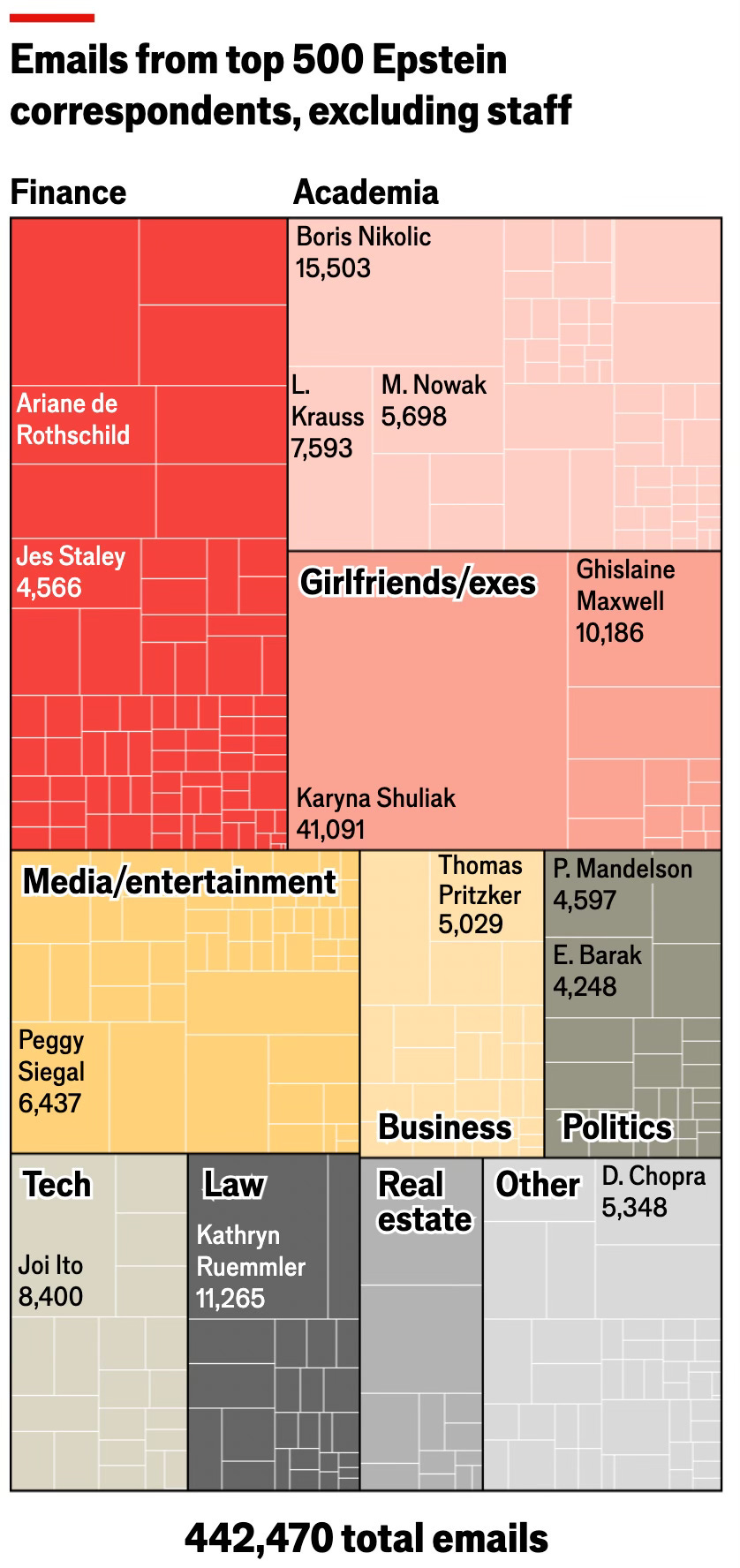
442,470 emails. That is the scale of the correspondence captured in Jeffrey Epstein’s files from his top 500 contacts, excluding staff. This chart maps where those emails came from, and the breadth of the network is as striking as the names within it.
The single largest correspondent was Karyna Shuliak, listed under girlfriends and exes, with over 41,000 emails. Ghislaine Maxwell, now serving a 20-year sentence for sex trafficking, exchanged more than 10,000. These are the people closest to the operation.
Beyond that inner circle, the network spans finance, academia, law, media, politics and tech. Boris Nikolic, a biotech investor and former adviser to Bill Gates, tops the academic category with over 15,000 emails. Kathryn Ruemmler, a former White House counsel, exchanged more than 11,000. Joi Ito, the former MIT Media Lab director who resigned after his financial ties to Epstein became public, appears in the tech category with 8,400.
In politics, Peter Mandelson and Ehud Barak are the most prominent named contacts. In finance, Ariane de Rothschild and Jes Staley, the former Barclays chief executive who faced regulatory scrutiny over his Epstein relationship, feature prominently.
The volume of correspondence does not by itself imply wrongdoing. People correspond extensively with many contacts for entirely legitimate reasons. What it does show is the extraordinary reach of a man who was, by the time of his 2019 arrest, a convicted sex offender. The question that the email archive poses, and that investigators and journalists continue to pursue, is what those relationships were built on and what they were used for.
Source: Economist – Off the charts
That gap between perception and reality is where much of modern politics now operates. Information moves faster than ever, yet it rarely produces a shared understanding of events.
I have included four additional charts in the full edition that explore how these dynamics are shaping politics and public opinion around the world. They are available to paid subscribers, so consider joining if you would like the complete analysis each week.
