

For $10 a month, or $100 a year, you support a simple mission: spread great data visualisation wherever it comes from. You help fund the work of finding, sourcing and explaining the charts that deserve a wider audience. And you back a publication built on generosity, transparency and the belief that better understanding makes a better world.CHART 1 • When Hormuz stopped and the world noticed
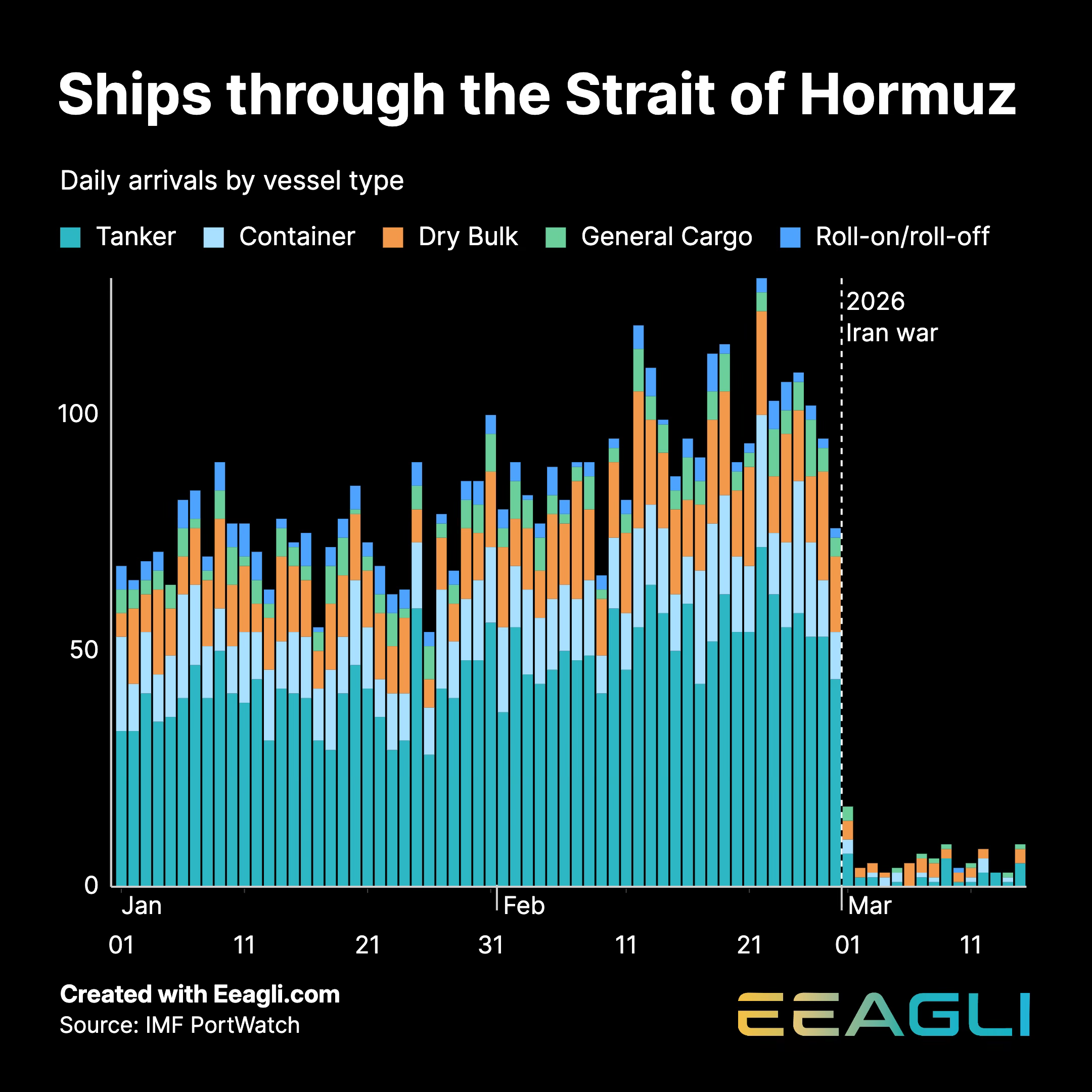
The collapse in traffic through the Strait of Hormuz only makes sense in the context of what unfolded at the end of February 2026. Following US and Israeli strikes on Iran, the conflict escalated rapidly into a direct confrontation. Within hours, Iran warned vessels not to transit the strait and began targeting shipping. The effect was immediate. Traffic fell by roughly 70% in days, then effectively to zero as operators withdrew altogether.
The chart captures that break with unusual clarity. January and February show a functioning system, with steady flows dominated by tankers. Then March arrives and activity collapses into single digit crossings. On some days, only three ships made it through.
What matters is why it switched off so completely. Around 60% of vessels in the strait are tankers, and the route carries close to 20% of global oil supply. Once attacks began and war risk insurance was pulled, the economics no longer worked. Ships were not blocked by geography, but by risk.
The chart therefore reflects something deeper than disruption. It shows how global trade behaves under extreme stress. It does not bend. It disappears.
Source: Eeagli
There is something unsettling about how quickly this shift has taken hold. Not because higher prices are unusual, but because of the speed and coordination of the move. It reminds us that the global economy is less stable than it appears when conditions are calm.
I have four more charts that expand on this story and show where this repricing could spread next, but they are for paid subscribers. Consider joining if you want the full edition.
