

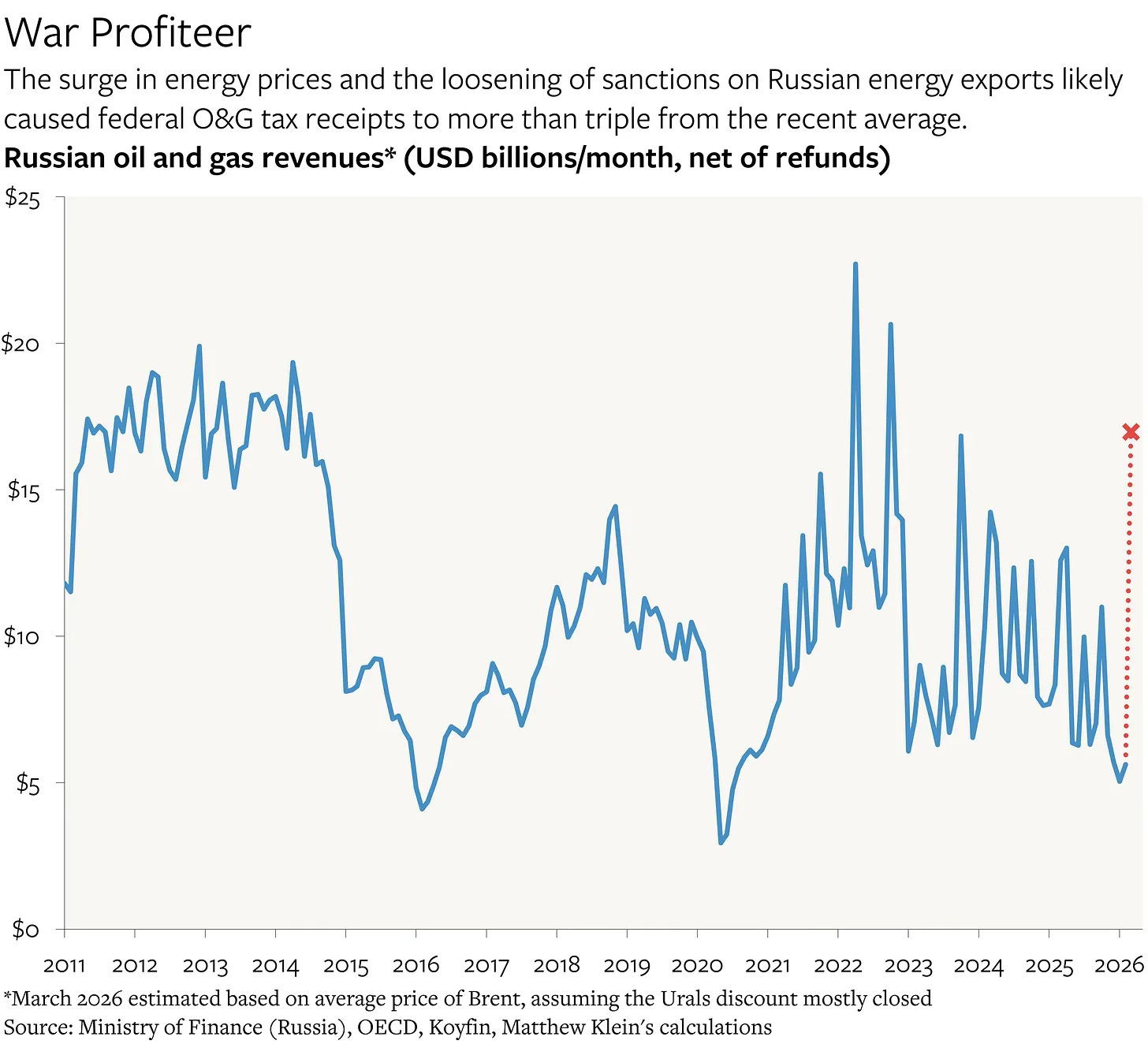
For $10 a month, or $100 a year, you support a simple mission: spread great data visualisation wherever it comes from. You help fund the work of finding, sourcing and explaining the charts that deserve a wider audience. And you back a publication built on generosity, transparency and the belief that better understanding makes a better world.CHART 1 • War in the Middle East can end up funding Russia’s war
As of yesterday, we have a tentative two-week pause in hostilities in the Middle East. Is it over? Who knows. It’s data that matters because it shows us how our lives might be affected.
I live in Europe so this chart stood out for me. The Middle East seems far away, while the war in Ukraine feels very close. But they are directly related. The closure of the Strait of Hormuz pushed energy prices higher. Even if the Strait fully opens up, the damage has already been done and oil prices are likely to remain elevated for some time. That’s great for Russia and its finances, while terrible for European security.
That is what gives the chart its force. Russia does not need to gain politically. If oil prices stay high and the discount on Russian crude narrows, Moscow can collect more revenue even under sanctions. In other words, turmoil in one region can still help fund war in another.
The broader point is that energy shocks do not stay neatly contained. They travel through markets, budgets and states. For Europeans, that makes this more than a chart about commodity revenues. It is a chart about how instability in the Gulf can quietly strengthen Russia’s war machine just as the threat to Europe remains very real. It’s not surprising therefore that Europe has been very reluctant to join Trump in his war against Iran.
Source: The Overshoot
We still like to talk about energy, inflation, demographics and security as if they belong in separate compartments. In reality, they bleed into one another all the time. A shipping disruption affects state revenues. State revenues affect war. War affects markets. Markets affect how much pain governments and households can absorb.
There is a deeper point in that. A dangerous world is not only one with more weapons or more conflict. It is one where the economic and strategic buffers are thinner, and where shocks in one region can quietly strengthen the forces making another region less safe.
I’ve got four more charts that expand on this story, but they’re for paid subscribers. Consider joining if you want the full edition.

