


For $10 a month, or $100 a year, you support a simple mission: spread great data visualisation wherever it comes from. You help fund the work of finding, sourcing and explaining the charts that deserve a wider audience. And you back a publication built on generosity, transparency and the belief that better understanding makes a better world.CHART 1 • US job growth had its weakest year in decades, and it was not a recession
Last month’s jobs report was strong. The annual picture tells a different story.
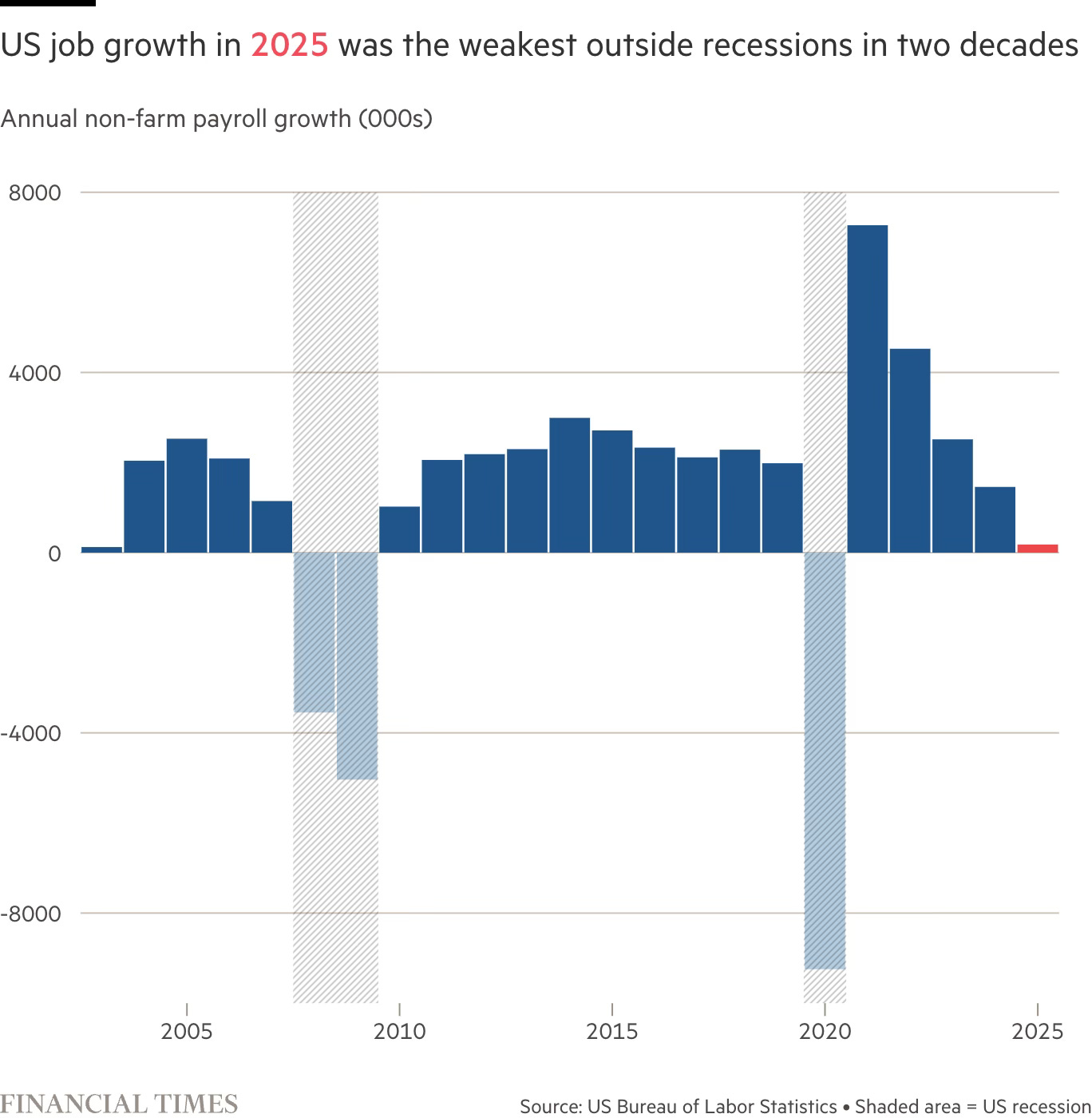
In 2025, the US added fewer jobs than in any non-recession year in the past two decades. Annual non-farm payroll growth was barely positive, far below the two to three million gains typical through most of the 2010s and well short of the post-pandemic surge in 2021 and 2022.
The tension is in the aggregation. Strong monthly readings can mask a broader deceleration, particularly when earlier months were weak or subject to revision. The chart captures the full year, not just the recent uptick.
What makes 2025 unusual is the absence of a recession. The shaded periods marking 2008 to 2009 and 2020 show when job growth previously fell this low. Outside those contractions, annual payroll growth has rarely been this weak.
The explanations are plausible but not reassuring. Higher interest rates have cooled hiring in housing and business investment. Pandemic catch-up hiring has run its course. Productivity gains and corporate caution may be restraining headcount even as output holds up.
None of that points to imminent collapse. But it does suggest the labour market is operating well below the pace that felt normal for much of the past decade. A strong month does not change that picture.
Source: Financial Times
It is tempting to treat each economic signal in isolation. A strong jobs report here. A soft unemployment print there. A rally in one sector, a slump in another. But taken together, the pattern is harder to ignore.
What strikes me is the gap between narrative and structure. Headlines fixate on the latest monthly jobs beat or miss. Investors debate whether a recession is imminent. But the deeper shifts are slower and more consequential. Hiring is cooling even without a downturn. Time is migrating back into the home. Screen usage is broadening across generations. The cycle is maturing, even if it has not yet turned.
I have four more charts that expand on this story and explore what a maturing cycle means for positioning and risk. They are for paid subscribers. Consider joining if you want the full edition and a clearer view of where this transition may lead.
