


Let’s start with climate action. Europe and parts of Asia have built emissions trading into the core of their strategy. The United States has not. The difference is not technical ability. It is political will. The same divergence appears in public health. The rise in obesity has been slow and unbroken for more than thirty years in the US, shaped not by choices alone but by environment, incentives and infrastructure. That’s what today’s charts are about.
Quick note — Killer Charts has been $8/month and $80/year since launch two years ago. From 1 December the price for new subscribers will rise to $10/month and $100/year. If you’ve been meaning to upgrade, you can lock in the old rate for life here.CHART 1 • The US lags badly on emissions trading coverage
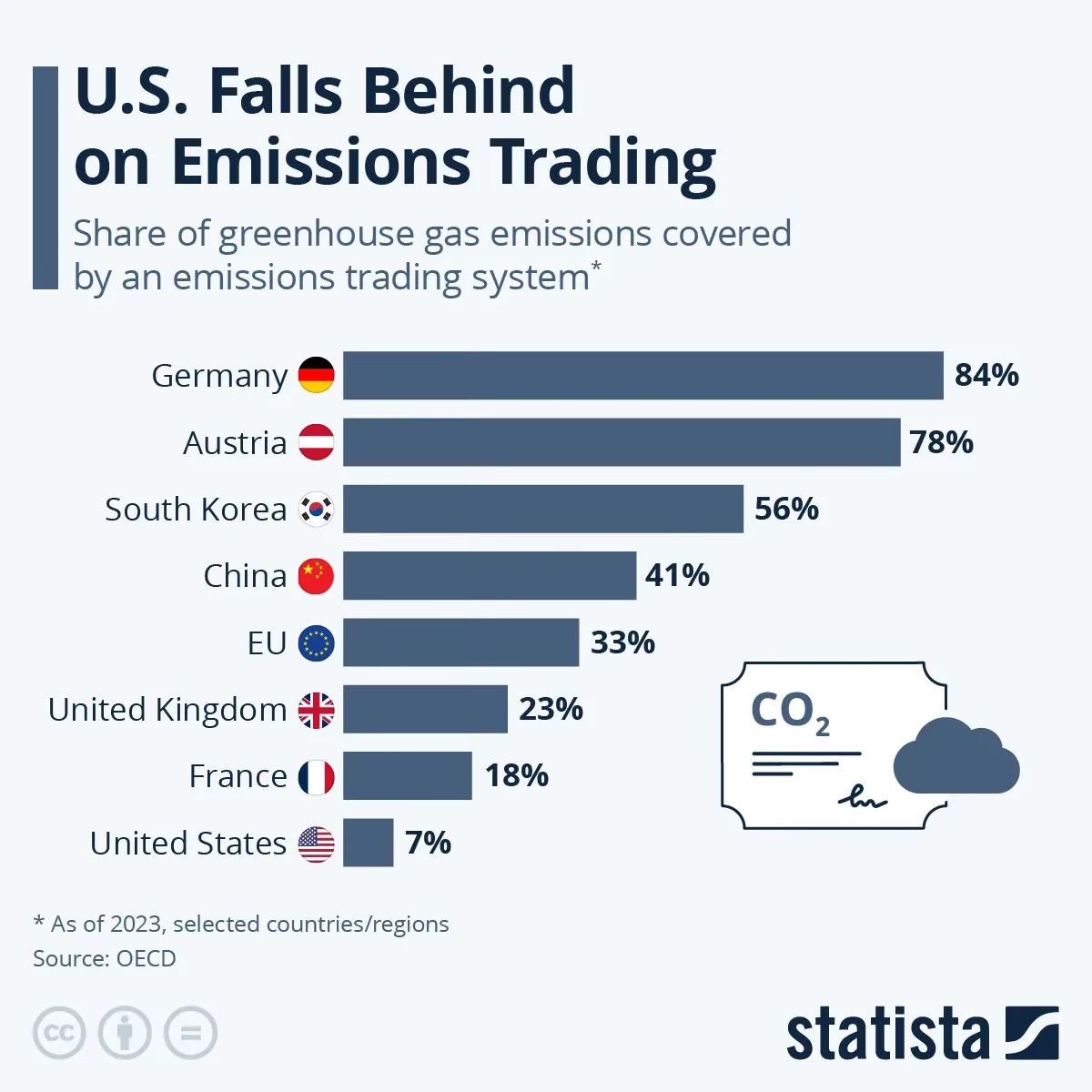
Many people assume the major economies are moving at roughly the same pace on climate policy. This chart shows how far that is from the truth. While emissions trading has become a central tool for reducing pollution across Europe and Asia the United States remains an outlier.
Germany and Austria now cover more than 75% of their emissions under trading systems. South Korea is above 50% and China has passed 40% with a national market that continues to expand. Even the wider EU average sits at 33%. These systems matter because they put a real price on pollution and create incentives for cleaner technology which is why so many countries treat them as the backbone of their climate strategy.
The United States by contrast covers only 7% of its emissions. That is not due to a lack of innovation or economic capacity. It reflects decades of political division inconsistent federal action and a heavy reliance on state level policies. The result is a fragmented system that does not match the scale of the challenge or the ambition seen elsewhere.
Source: Statista
What unnerves me across these charts is the mismatch between risk and response. Climate incentives work in much of the world yet remain patchy when it comes to worldwide adoption. Health systems bear the cost of an obesity trend that policy hardly touches, and that is a problem across the world.
I have got four more charts that expand on this story but they are for paid subscribers. Consider joining if you want the full edition.
