

For $10 a month, or $100 a year, you support a simple mission: spread great data visualisation wherever it comes from. You help fund the work of finding, sourcing and explaining the charts that deserve a wider audience. And you back a publication built on generosity, transparency and the belief that better understanding makes a better world.CHART 1 • The IPO backlog reflects private capital power
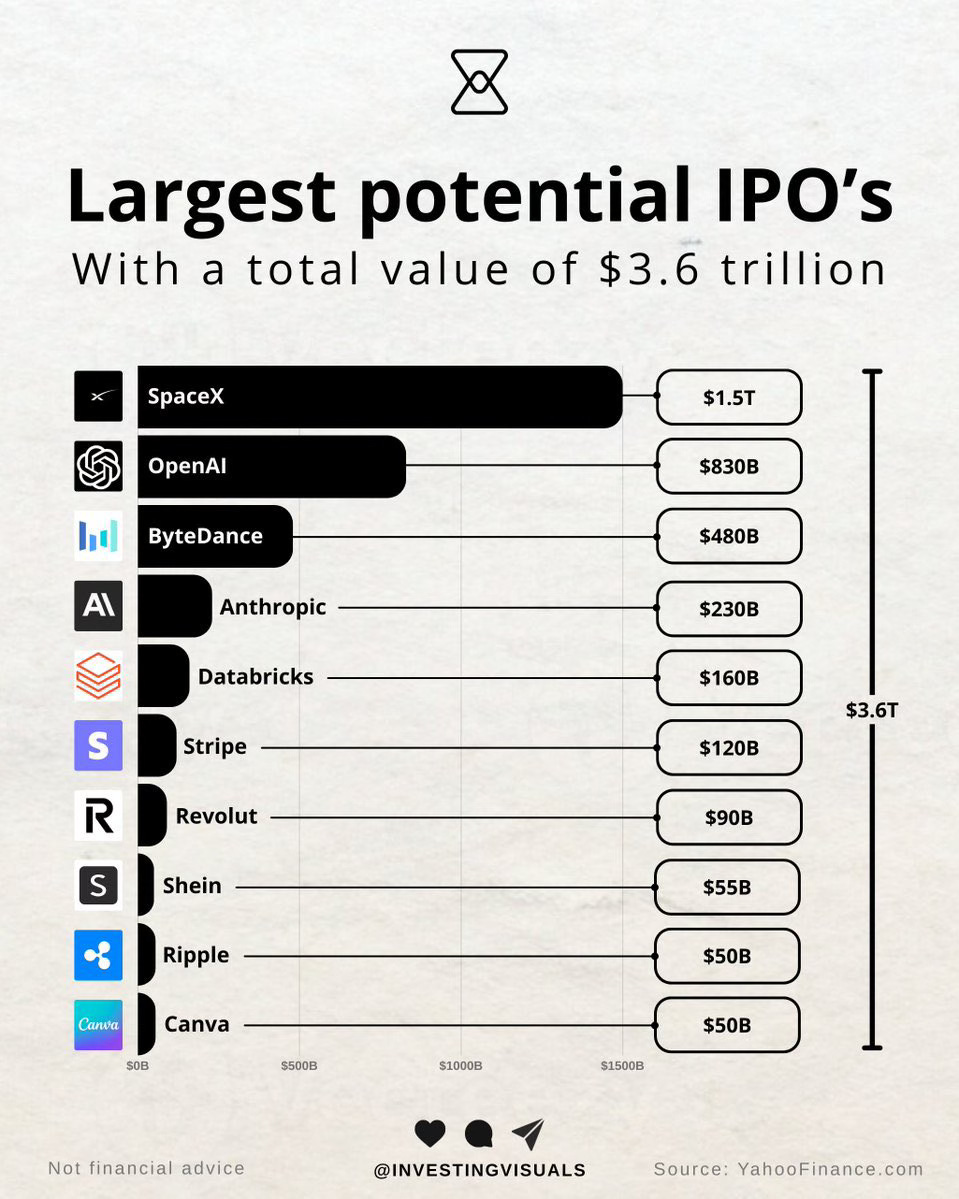
The IPO pipeline is no longer made up of mid-sized companies waiting for better market conditions. It is dominated by firms already worth hundreds of billions of dollars.
SpaceX alone is valued at around $1.5 trillion. OpenAI, ByteDance, Anthropic, Stripe and Databricks are each valued at levels that would once have put them straight into public markets. Taken together, the largest potential IPOs are now worth roughly $3.6 trillion.
This is not because public markets are closed, but rather because private capital can now do what public markets used to do better. Late stage investors now write very large cheques. They fund expansion, allow early employees to sell shares, and do so without the scrutiny or loss of control that comes with a public listing.
What has changed is not access to money, but rather control. Companies can now raise large sums privately, manage their ownership, and give employees liquidity without listing. They go public only when regulation tightens, staff need cash, or the balance sheet leaves them little choice.
Source: Investing Visuals
The IPO backlog makes the point most clearly. Companies worth hundreds of billions can stay private because they can fund growth, manage ownership and offer liquidity on their own terms. Access to capital is not the constraint. Control is.
I have four more charts that reflect this story and look at where concentration is tightening next. They are for paid subscribers. Consider joining if you want the full edition.
