


I don't like tariffs because they end up as a tax on your own economy. Prices rise, supply chains twist out of shape and the promised benefits rarely show up. If the goal is stronger industry and cheaper goods, tariffs usually deliver the opposite.
What makes the current US approach so frustrating is the gap between the tough talk and the carve outs. The headline is sweeping, yet the most important technology inputs are exempt because the AI and data centre build depends on them. Computers, servers and chip components still come in without tariffs, which is why computers and parts dominate the exception list. That is an admission that the economy needs these imports and cannot afford to choke them.
My view is simple. This creates a two tier system that raises costs for many while quietly protecting what cannot be disrupted. Big tech inputs slip through untaxed, smaller importers and consumers carry more of the burden, and the policy contradicts itself in the fine print. The chart that follows makes that contradiction visible.
CHART 1 • The big tech exceptions with US tariffs
America’s tariff regime is full of exceptions and the biggest of all is computers and parts. Despite the sweeping trade measures introduced this year, tens of billions of dollars’ worth of technology imports continue to enter the country without tariffs.
In July 2025, computers and parts were by far the largest category of tariff-exempt imports, outpacing pharmaceuticals, energy and even USMCA-compliant goods from Mexico and Canada. The exemption covers critical inputs for America’s booming AI and data centre industries, which rely heavily on imported chips, servers and components. Smartphones, precious metals and energy products also benefit, but none come close to the scale of the tech exemption.
This approach reflects a long-standing tension in trade policy. On one hand, tariffs are used as a political tool to reshape global supply chains. On the other, exemptions reveal where the US remains dependent on foreign products and cannot afford disruption.
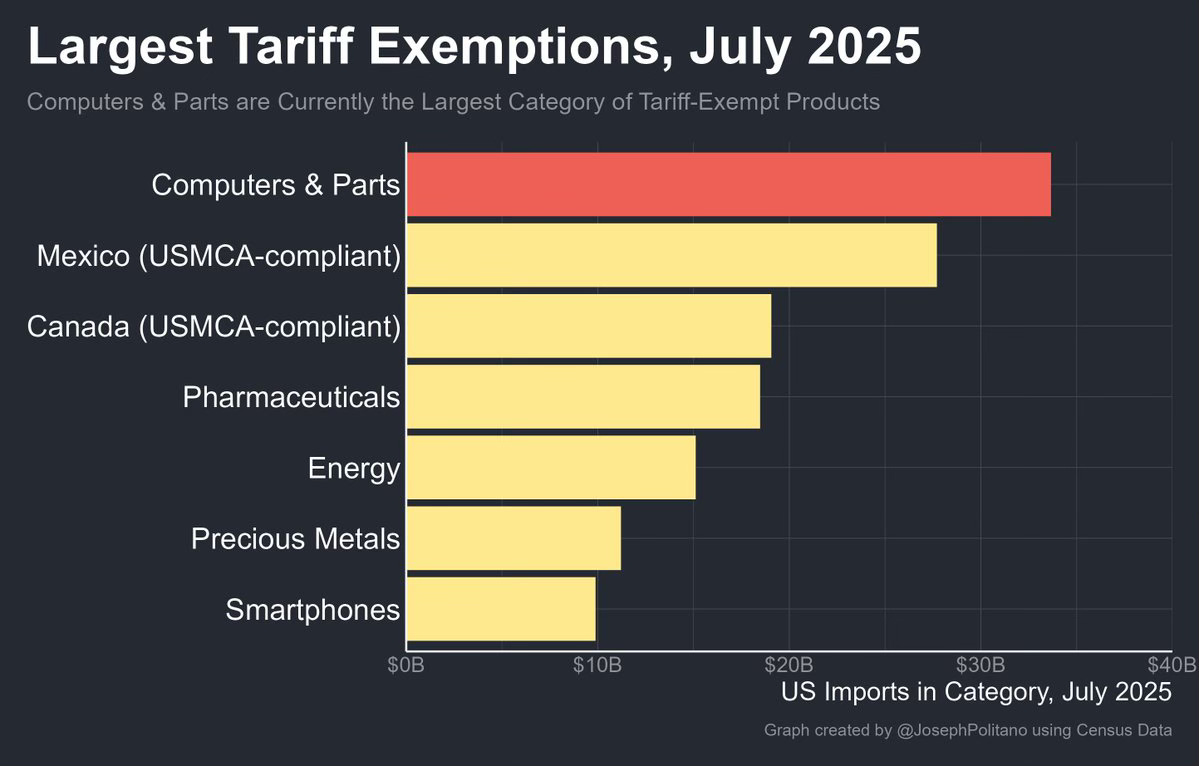
Source: Joey Politano
I find this chart particularly compelling because it’s unlike anything I’ve encountered before. Yet it makes perfect sense, as it captures precisely the narrative I’ve just outlined above. The tariff system is inefficient, and the sheer number of exemptions reveals it as fundamentally broken. This point deserves proper attention, and the chart illustrates it brilliantly with remarkable simplicity.
I’ve got several more charts to share that I think are equally revealing, though you’ll need to be a paid subscriber to access them.
