


For $10 a month, or $100 a year, you support a simple mission: spread great data visualisation wherever it comes from. You help fund the work of finding, sourcing and explaining the charts that deserve a wider audience. And you back a publication built on generosity, transparency and the belief that better understanding makes a better world.CHART 1 • SpaceX has given the US a decisive orbital edge
If you work anywhere near space, defence, or satellite infrastructure, launch access is no longer a technical detail. It determines who can put satellites into orbit quickly, replace them when they fail, and add more capacity without waiting months for a launch slot.
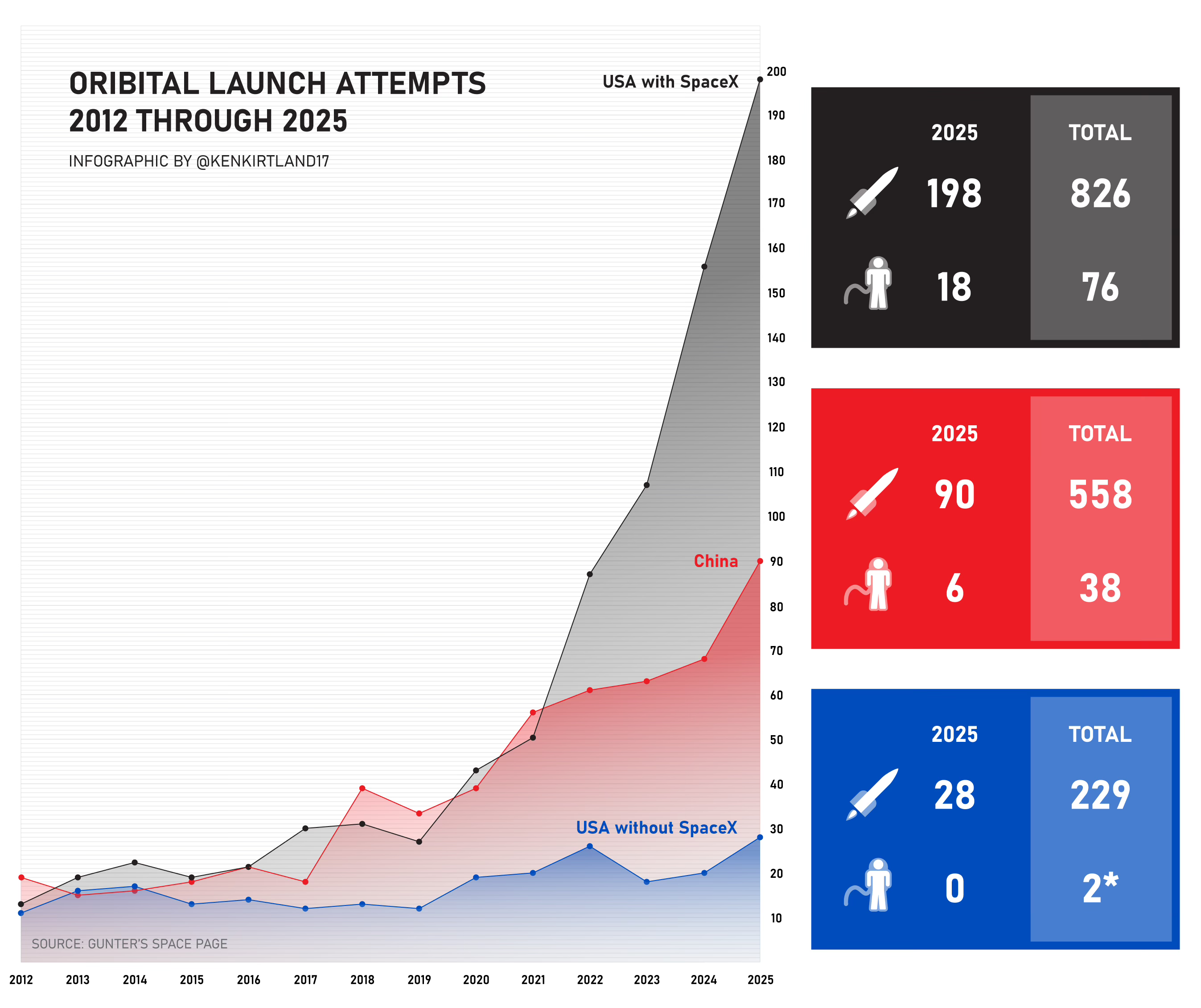
Over the past decade, the number of rocket launches has risen steadily, but the balance has shifted sharply. The US now carries out far more launches than any other country, almost entirely because of SpaceX. By 2025, SpaceX alone is flying close to two hundred missions a year. That is more than China launches in total, and vastly more than the rest of the US space sector combined. China’s launch rate has increased, but much more slowly. Other countries barely register by comparison.
This is still often described as a race between countries. It is not. The real constraint is how often you can launch, how cheaply you can do it, and whether you can reuse rockets instead of rebuilding them each time. SpaceX solved that problem first. As a result, the US can put things into orbit faster, replace them faster, and scale up faster than any rival. Countries without a similar launch system are not just behind on paper, they are constrained by how rarely they can put hardware into space, regardless of how advanced their technology may be.
Source: Ken Kirtland
What struck me putting this edition together is how often we confuse activity with resilience. Launches are rising, cars are selling, jobs still exist, oil still flows. Yet in most systems the underlying flexibility is shrinking. Capacity is concentrated, adjustment is slow, and once momentum fades there are few levers left to pull. However, there are outlier, and often this is where the US excels.
Space is one of them. The US advantage is not the number of satellites in orbit, but the ability to replace, expand and adapt quickly because launch itself is no longer the constraint. Another example is AI. The US has an enduring lead even over China. It’s not just because it can innovate, but because it move quickly and comfortably into what is at times, the depths of the unknown.
I have four more charts to share with you, but you will have to be a paid subscriber.
