


For $10 a month, or $100 a year, you support a simple mission: spread great data visualisation wherever it comes from. You help fund the work of finding, sourcing and explaining the charts that deserve a wider audience. And you back a publication built on generosity, transparency and the belief that better understanding makes a better world.
CHART 1 • Software hiring has reversed course
We’ve long heard concerns about white-collar jobs being lost to AI, and to an extent those concerns are justified. There are so many jobs that can now be automated, made more efficient, or even replaced by AI.
However, what’s not often mentioned is the new white-collar jobs that are likely to be created by AI. The most obvious example is software developers, who these days need good AI skills. A software engineer needs to know how to incorporate AI into their workflow to be more efficient, whether that requires refactoring code or managing the broader suite of technology that powers a piece of software.
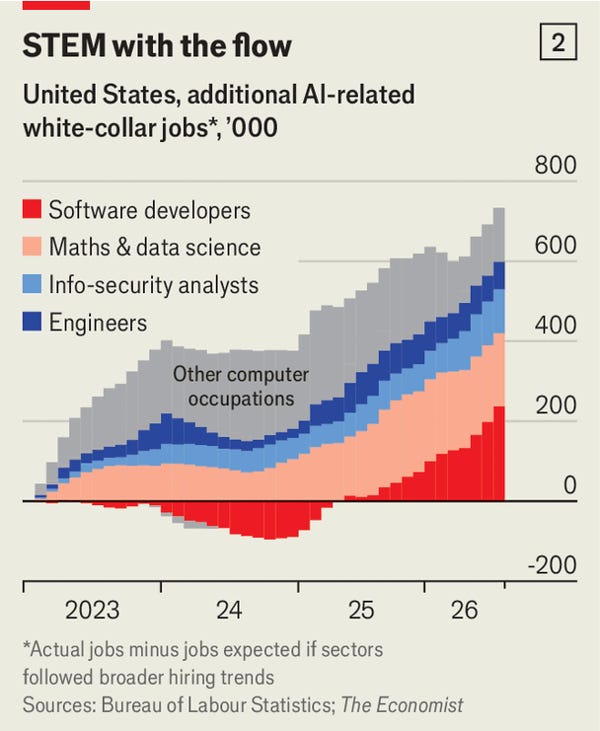
Source: The Economist
Then there is the security industry, where AI jobs are needed to uncover security weaknesses and patch up defences. Engineering also requires AI jobs across the spectrum to rapidly accelerate development in multiple applications.
I think the message here with this chart from the Economist is that the future is not all bleak. What we are seeing is a restructuring of the economy, and consequently also the jobs market.
Paid subscribers get access to the other four charts: occupations gaining from AI, America’s private-funding lead, surging data-centre construction and the software vulnerability queue. Together, they show how AI redistributes work, capital and operational risk.
