

For $10 a month, or $100 a year, you support a simple mission: spread great data visualisation wherever it comes from. You help fund the work of finding, sourcing and explaining the charts that deserve a wider audience. And you back a publication built on generosity, transparency and the belief that better understanding makes a better world.CHART 1 • Record 45% of Americans now identify as independent
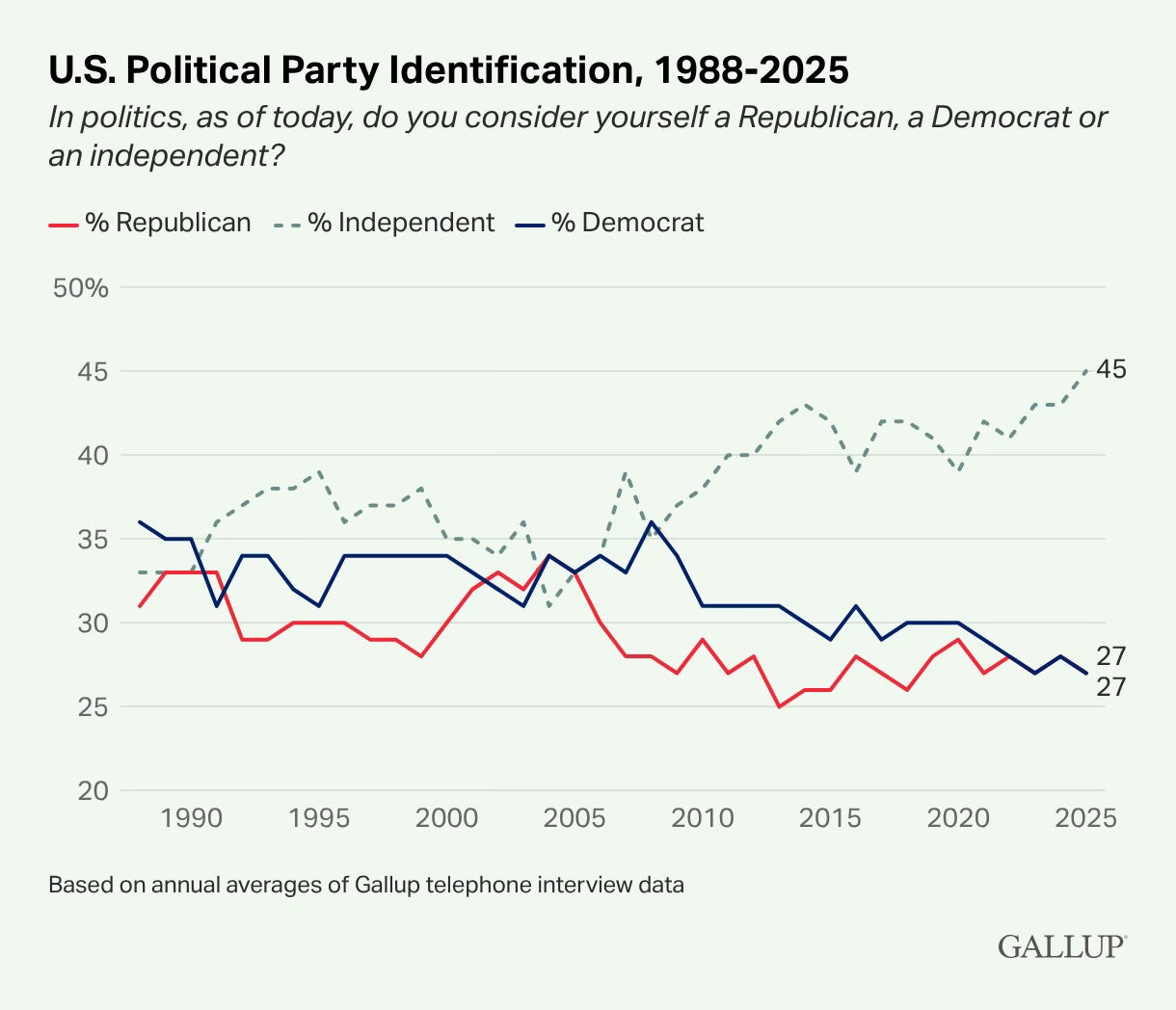
The two party system still structures US elections. But more Americans now say they belong to neither party. This chart shows that in 2025, 45% of Americans identify as independent, compared with 27% as Democrat and 27% as Republican, based on Gallup’s annual averages.
That marks a long-term shift. In the late 1980s and early 1990s, Democrats and Republicans both sat in the low to mid-30s. Independents were smaller and fluctuated around the mid-30s. Over time, formal party identification has declined while the independent share has climbed steadily.
Since around 2010, independents have consistently outnumbered either party. The gap has widened further in the past decade. Today, the largest political group in America is neither Democrat nor Republican.
This does not mean most independents are politically neutral. Many lean toward one party when voting. Gallup’s measure captures self identification, not electoral behaviour. But the label itself signals something important. Fewer Americans are willing to attach themselves formally to a party brand, even as political polarisation intensifies.
Source: Gallup
Across the United States and Britain, something subtle but powerful is shifting. Fewer people want to wear a party label. More people are taking to the streets (in the US). And when asked what they want from government, the answers are no longer as predictable as they once were.
I have four more charts that expand on this story and dig deeper into where this disconnect may lead. They are for paid subscribers. Consider joining if you want the full edition and a clearer view of how this political and economic cycle might unfold.
