


For $10 a month, or $100 a year, you support a simple mission: spread great data visualisation wherever it comes from. You help fund the work of finding, sourcing and explaining the charts that deserve a wider audience. And you back a publication built on generosity, transparency and the belief that better understanding makes a better world.CHART 1 • How sanctions reshaped oil trade rather than stopping it
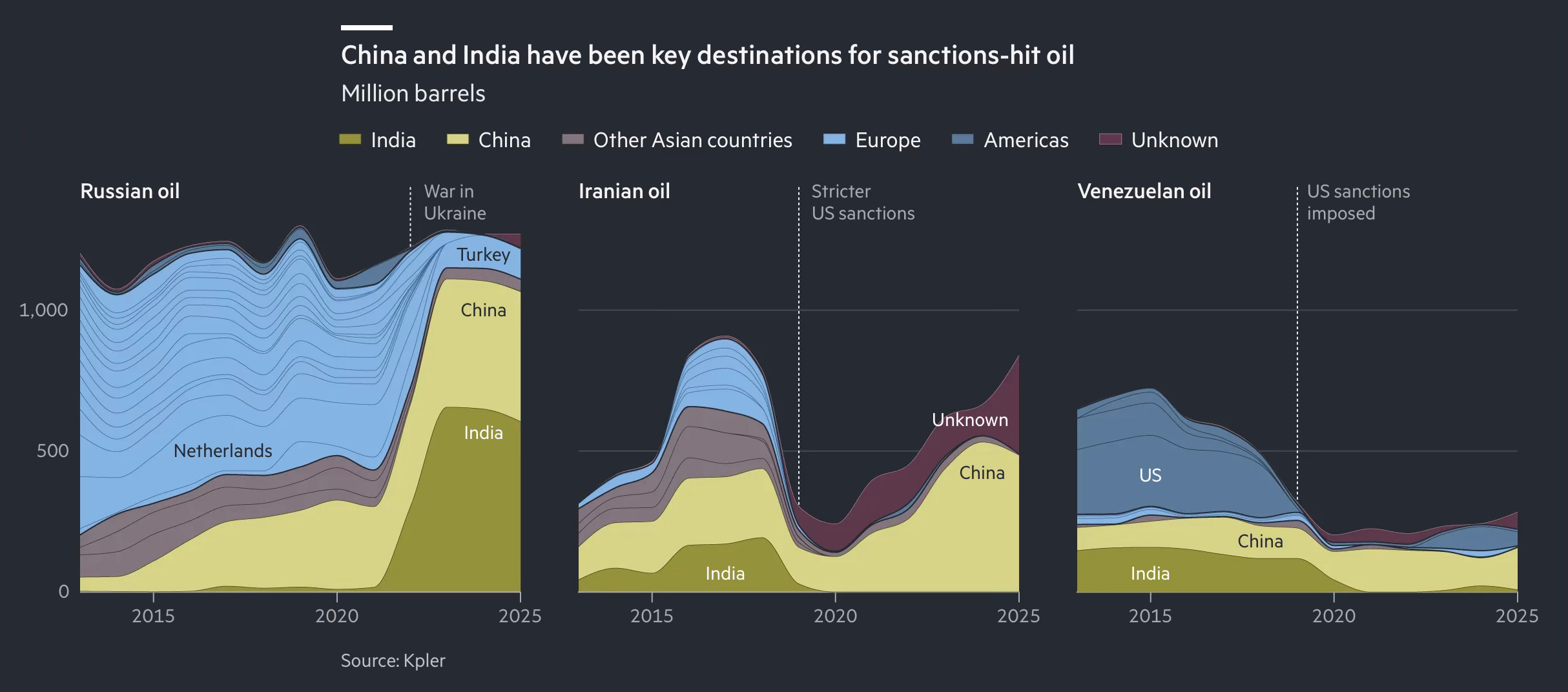
What makes this chart so striking is that it shows sanctions did not choke off Russian, Iranian and Venezuelan oil. They rerouted it. Europe largely disappeared as a buyer of Russian barrels after the invasion of Ukraine, while India and China absorbed much of the displaced flow. Iran’s sanctioned oil has also ended up heavily concentrated in China, and the recent Middle East war has given both Russian and Iranian exports more room to move again.
That matters because the story here is not just about oil, but about the survival of a parallel trading system. The shadow fleet is no longer some temporary workaround. It has become a durable part of the market, using older ships, opaque ownership and evasive tactics to keep sanctioned crude flowing.
The reason this feels so relevant now is that conflict has not only lifted oil prices. It has also eased pressure on the very networks that help fund Russia and Iran. So this is not really a chart about where the barrels go. It is about how geopolitical shocks keep rewarding the people best able to move oil outside the formal system.
Source: Financial Times
Often policy aims at one thing and delivers another. Sanctions are meant to constrain. Tariffs are meant to bring production home. Conflict is meant to weaken adversaries. Yet the data keeps showing a world that adjusts, reroutes and carries on, often in ways that leave the underlying dependencies intact.
There is something sobering in that. Modern trade is not especially elegant, but it is remarkably hard to unwind. Once supply chains, shipping routes and energy networks are built, they develop a kind of inertia of their own. Politics can push them around. It rarely remakes them as easily as promised.
I’ve got four more charts that expand on this story, but they’re for paid subscribers. Consider joining if you want the full edition.
