

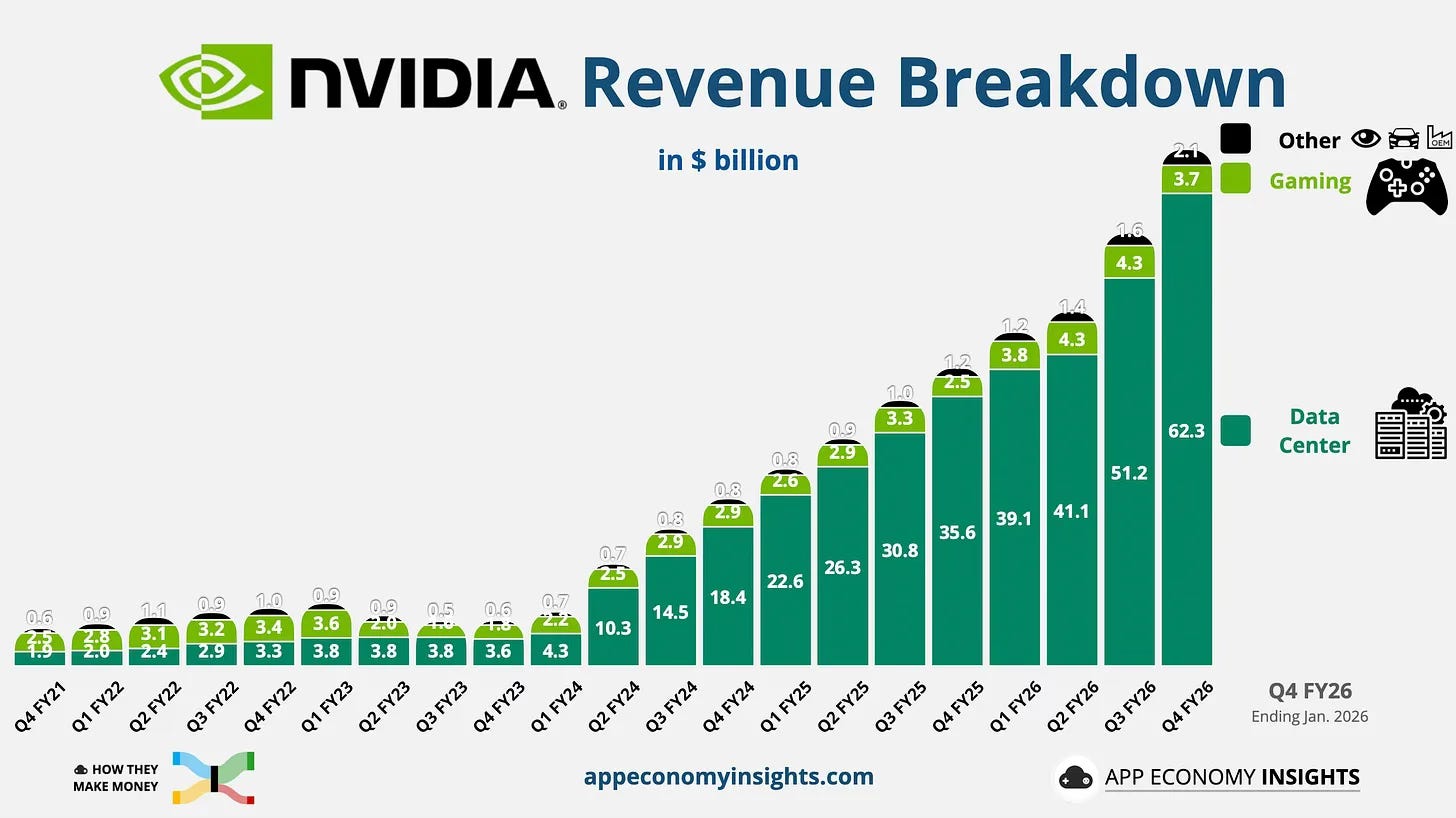
For $10 a month, or $100 a year, you support a simple mission: spread great data visualisation wherever it comes from. You help fund the work of finding, sourcing and explaining the charts that deserve a wider audience. And you back a publication built on generosity, transparency and the belief that better understanding makes a better world.CHART 1 • How artificial intelligence transformed Nvidia’s business
For most of its history Nvidia was known primarily as a gaming company. Graphics processing units designed for video games formed the backbone of its revenue and shaped its identity within the semiconductor industry. That structure has now changed so dramatically that the original business almost looks secondary.
This chart illustrates how quickly this shift has occurred. Earlier in the decade Nvidia’s revenue streams were relatively balanced, with gaming contributing a large share of the company’s income. Over the past two years the data centre division has surged, with quarterly revenue rising into the tens of billions of dollars and dwarfing every other part of the business.
This expansion reflects the rapid buildout of artificial intelligence infrastructure. Training and operating large machine learning systems requires enormous computing power, and Nvidia’s chips have become central to that effort. As technology firms and cloud providers raced to expand capacity, Nvidia found itself supplying the hardware behind the entire wave.
The result is a company that now looks less like a consumer technology supplier and more like a provider of core digital infrastructure. Gaming still exists as a business, but it no longer defines Nvidia in the way it once did.
Source: App Economy Insights
Artificial intelligence is often discussed as if it were a single industry moving in the same direction. In reality it is an ecosystem where different players face very different economics.
History suggests that the most important question is rarely who builds the technology first. It is who eventually finds a durable business model around it. The companies that succeed are often not the ones that attract the most attention at the start.
I have included four additional charts in the full edition that explore where the money is really flowing inside the AI economy. They are available to paid subscribers, so consider joining if you would like the complete analysis each week.
