


The European Central Bank (ECB) is under a lot scrutiny. It needs to manage a huge bond pile and how it does this matters.
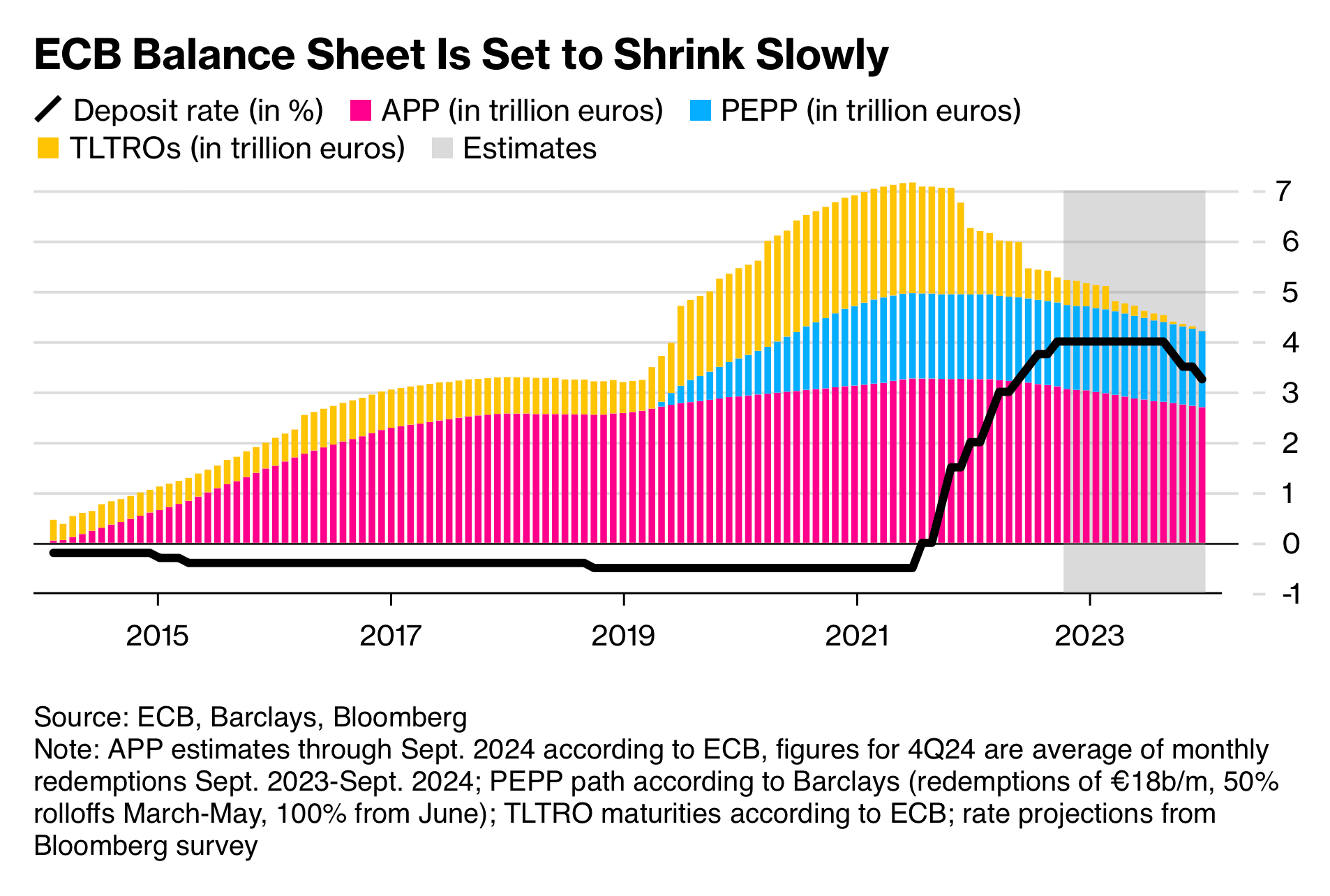
The ECB's balance sheet is forecasted to contract slowly through a mixture of strategies as you can see in our first chart. The goal is to wind down an array of tongue-twisting complex schemes that make up the ECB’s debt pile.
Without giving you too much of a headache, these include the Asset Purchase Programme (APP), Pandemic Emergency Purchase Programme (PEPP), and Targeted Long-Term Refinancing Operations (TLTROs).
The ECB’s balance sheet is set to shrink slowly
So that’s great right!
What’s the big deal if the balance sheet is now shrinking.
Well, some experts believe that the way the ECB is putting money back into bonds (reinvesting) doesn't match their goals for setting interest rates.
For instance, raising interest rates encourages less spending in the economy. At the same time, reinvesting in bonds (which takes money out of circulation), adds to this effect by reducing the amount of money circulating through the economy.
Another worry is that if the ECB doesn't reinvest enough and instead lets those investments expire, there might not be enough stability in the markets, especially during tough times.
In short, the ECB has a delicate balancing act to make as it gradually reduces its balance sheet.
Coming up:
Weaker commodities demand underscores a global slowdown
Germany is still far from reaching its 2030 emission goal
A GDP comparison between the G7 and BRICS
Germany’s recovery from Covid has been the weakest among advanced economies
If you would like to view these charts, why not become a paid subscriber? You would be actively supporting me and the work I do. You can even take out a free one-week trial.
