

For $10 a month, or $100 a year, you support a simple mission: spread great data visualisation wherever it comes from. You help fund the work of finding, sourcing and explaining the charts that deserve a wider audience. And you back a publication built on generosity, transparency and the belief that better understanding makes a better world.CHART 1 • Europe’s military strength is more fragmented than it appears
From a distance, Europe looks heavily armed. Most countries maintain standing forces, defence budgets have risen since 2022, and NATO membership now stretches further east than it did a decade ago. On paper, the numbers suggest depth.
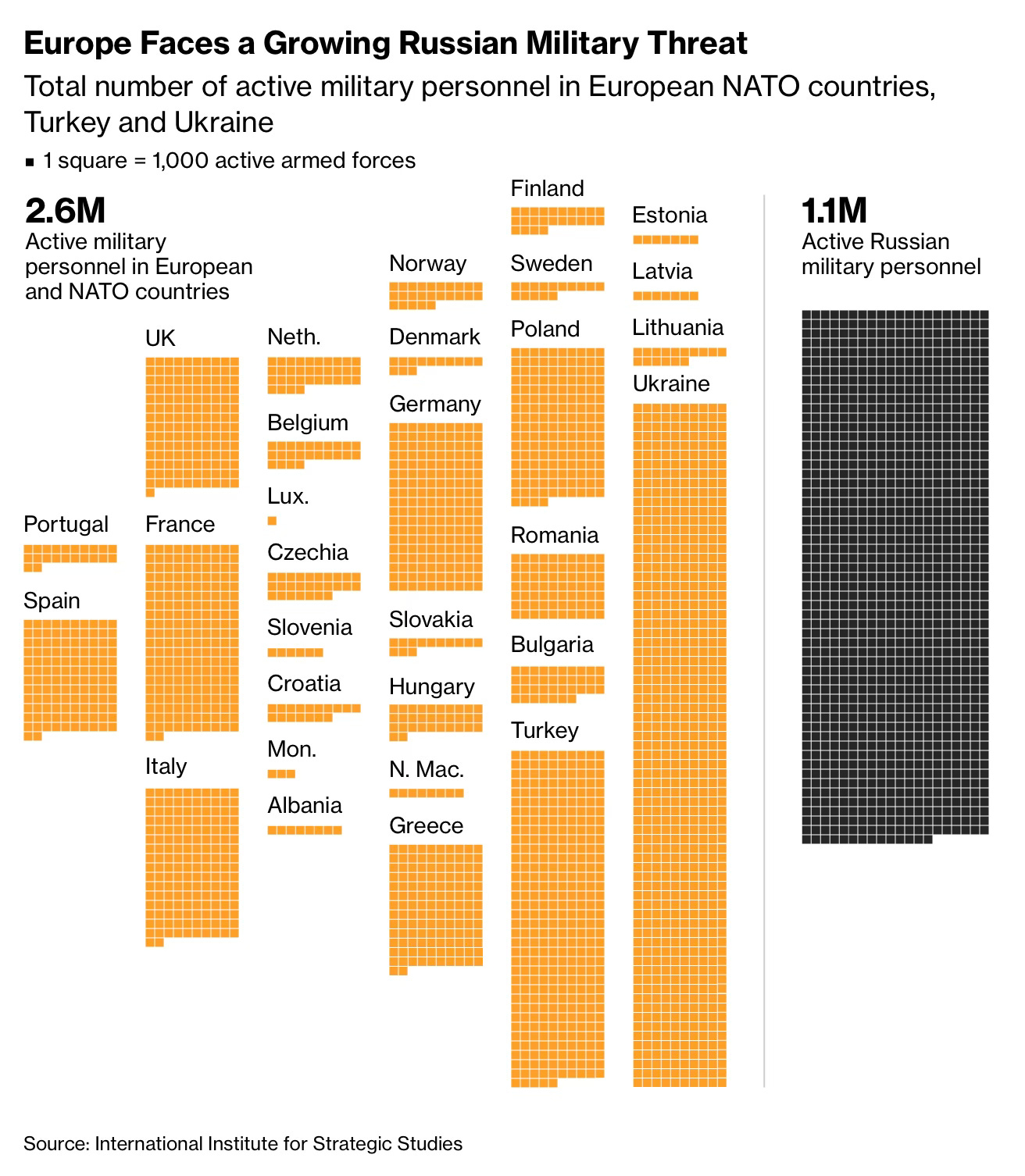
Taken together, European NATO countries, Turkey, and Ukraine field around two and a half million active personnel. That exceeds Russia’s standing force, which is closer to one million. But those troops are spread across more than two dozen national militaries, each with its own command structures, equipment standards, readiness levels, logistics chains, and political constraints. Russia’s forces sit within a single system, organised for continuity, mobilisation, and sustained operations.
The common assumption is that aggregate headcount equals deterrence. It does not. Deterrence rests on whether force can be concentrated, commanded, supplied, and deployed quickly and credibly. Fragmentation weakens that signal, even when total numbers look favourable, especially when forces are designed primarily for national defence rather than joint mobilisation.
If manpower is divided across so many systems, how much usable force can Europe actually bring to bear in a fast moving crisis?
Source: Bloomberg
What stayed with me working through these charts is how little of this depends on formal intent. Europe does not lack soldiers, but it lacks cohesion. Power compounds not through dramatic breaks, but through systems that make action easier for some and harder for others. By the time outcomes look obvious, the underlying structure has already done the work.
You see the same pattern in how the EU often operates more broadly. Capacity exists, but coordination is uneven, and that inconsistency shapes what can actually be delivered economically.
I have four more charts that extend this story and look at where these imbalances may harden next. They are for paid subscribers. Consider joining if you want the full edition.
