


For $10 a month, or $100 a year, you support a simple mission: spread great data visualisation wherever it comes from. You help fund the work of finding, sourcing and explaining the charts that deserve a wider audience. And you back a publication built on generosity, transparency and the belief that better understanding makes a better world.
CHART 1 • Productivity growth has outrun real wages in the US and UK
Productivity growth is enormously important because it determines how much an economy can produce from each hour worked. In theory, rising productivity creates room for higher wages, stronger profits and better living standards. But it does not guarantee that the gains will be shared equally.
These two Financial Times charts examine that question for the US and UK. They show that labour productivity has risen considerably faster than the purchasing power of workers’ hourly compensation over long periods.
This is because labour productivity isn’t solely driven by people working harder. It can also increase because workers are given better machinery, software and infrastructure or because companies reorganise production. And the newest innovation to help boost productivity is AI.
AI might help workers produce more, but it may also replace parts of their work while directing a greater share of the gains towards the companies that own the technology and computing infrastructure.
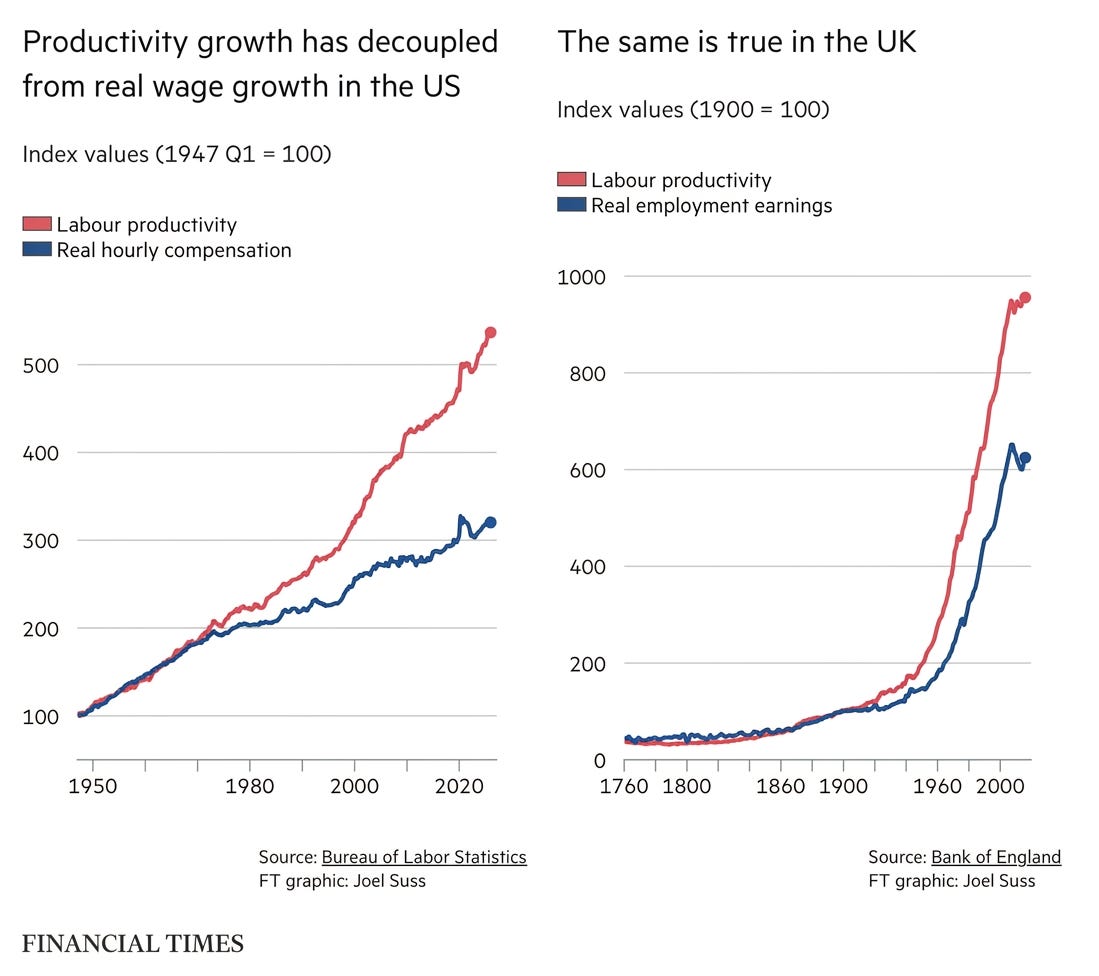
Source: Financial Times
I’ve always had an issue with economic growth because it really depends on what’s driving it. For instance, too much debt can drive economic growth in an unhealthy way. Likewise, the same issue applies to productivity. Increasing productivity can also lead to economic growth, but it can lead to job losses and wages rising less quickly, as you can see in the chart above. These are the issues that we really need to address.
Paid subscribers get access to the other four charts: America’s four rental markets, record US mortgage debt-to-income ratios, UK small boat arrivals and Eritrean small boat arrivals. Together, they show how living-standard pressure appears in housing markets, household credit and migration routes.
