

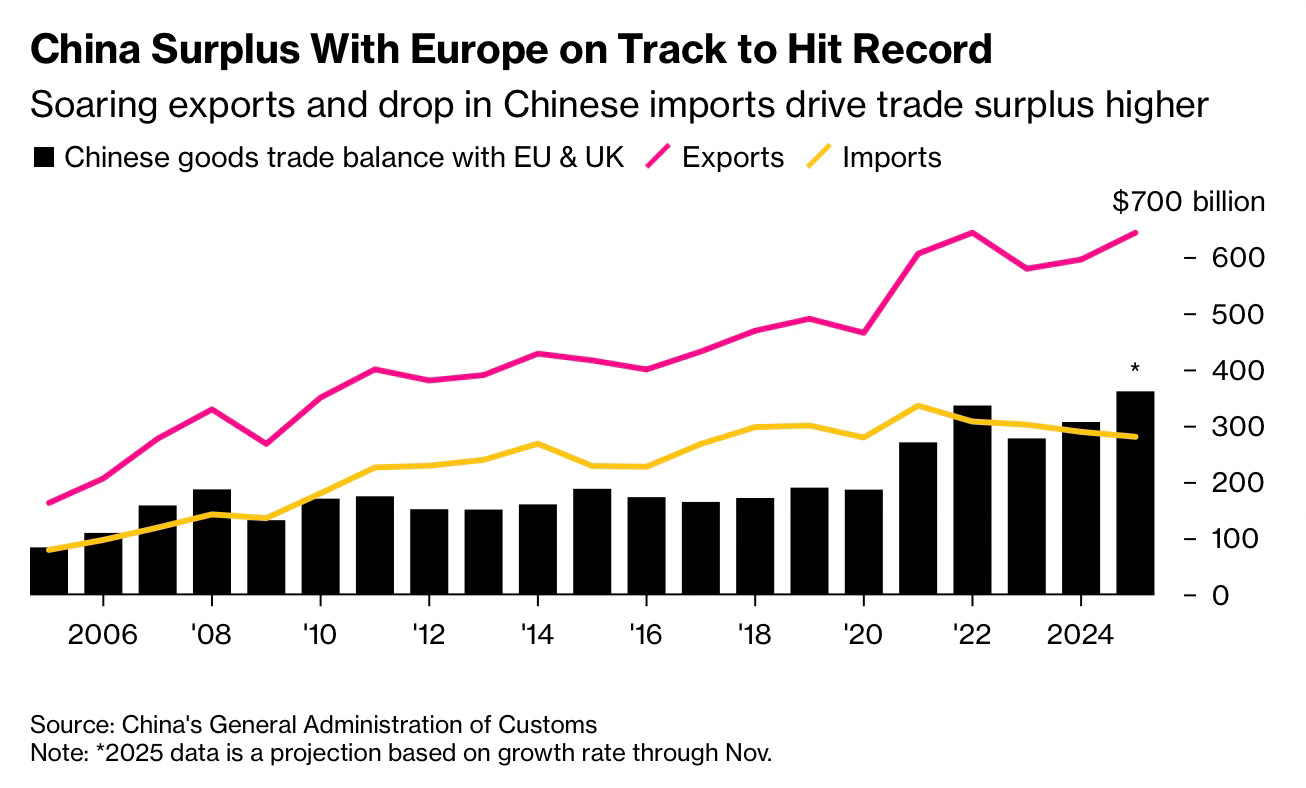
For $10 a month, or $100 a year, you support a simple mission: spread great data visualisation wherever it comes from. You help fund the work of finding, sourcing and explaining the charts that deserve a wider audience. And you back a publication built on generosity, transparency and the belief that better understanding makes a better world.CHART 1 • China’s trade surplus with Europe is becoming entrenched
China’s trade surplus with Europe is no longer a temporary distortion caused by the pandemic or supply chain disruption. It is becoming a structural feature of the global economy.
This chart shows Chinese exports to the EU and UK continuing to rise while imports into China have stagnated or fallen. The result is a widening surplus that is now on track to approach $700 billion. That scale matters because it reflects a persistent mismatch between production and demand.
China is exporting excess industrial capacity into European markets while domestic demand at home remains weak. European firms, meanwhile, are selling less into China as growth slows and competition from domestic Chinese producers intensifies.
Large trade imbalances do not stay economic for long. They become political. European manufacturers face margin pressure. Governments face calls for tariffs, subsidies and defensive industrial policy.
This is not about short term competitiveness. It reflects diverging growth models and state support.
Source: Bloomberg
What stands out to me is how quietly the rules have changed. For years, demographic decline, trade imbalances and industrial intervention were treated as long term concerns. Now they are shaping decisions in real time, from factory locations to capital allocation.
There is a tendency to analyse each chart in isolation. But the deeper insight sits in the connections. Weak demand feeds surplus. Surplus feeds political response. Politics reshapes markets. None of this is temporary.
I have four more charts that extend this analysis and look at where the next pressure points are likely to emerge. They are for paid subscribers. Consider joining if you want the full edition and a clearer view of how global power is being rebalanced.
