

For $10 a month, or $100 a year, you support a simple mission: spread great data visualisation wherever it comes from. You help fund the work of finding, sourcing and explaining the charts that deserve a wider audience. And you back a publication built on generosity, transparency and the belief that better understanding makes a better world.CHART 1 • China’s power demand is rising far faster than everyone else’s
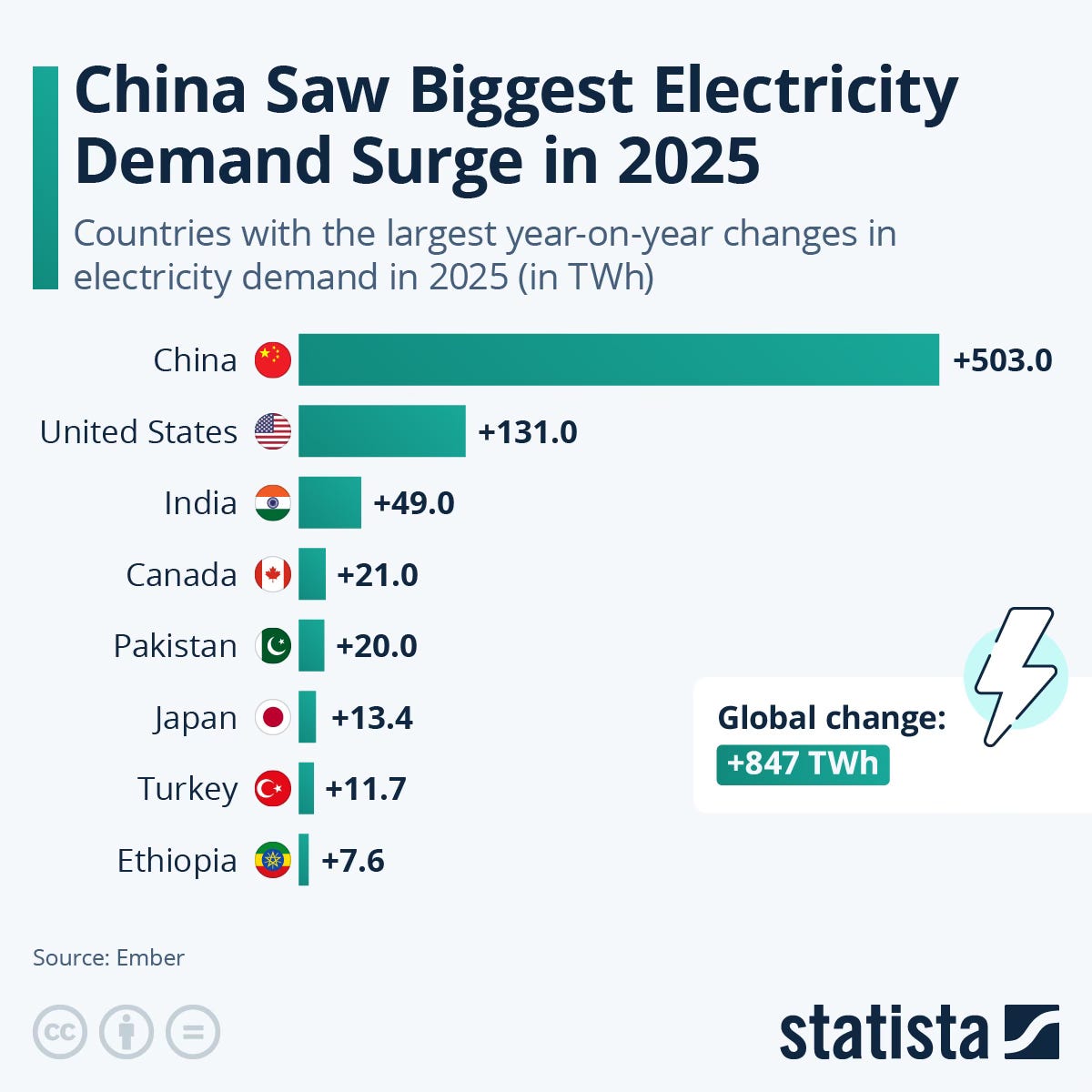
The eye catching number is not simply that China added 503 TWh of electricity demand in 2025. It is that this one country accounted for well over half of the world’s total increase. According to Ember, global demand rose by 847 TWh, which means China alone generated most of the growth.
That is not just a story about factories. China’s economy is becoming more electric in several directions at once. Ember says the country now accounts for a third of global electricity demand for the first time, while the IEA points to rising use from air conditioning, electric vehicle charging, data centres, 5G networks and the manufacturing of batteries, solar cells and new energy vehicles.
The broader point is that China is no longer merely the world’s workshop. It is becoming the central arena of electrification itself. That helps explain why its power demand is pulling away from the US and Europe, and why any serious discussion of future energy systems now starts with China.
Source: Statista
Big stories can hide uneven realities. China’s electrification is enormous, but it is not the same as global energy demand rising evenly. America’s manufacturing boom is real, but not broad. Transport stocks are stronger, but not necessarily shouting that the whole economy is healthy.
That is why charts matter. They force us to separate the slogan from the structure beneath it. A boom can be narrow. A recovery can be fragile. A powerful trend can still depend on a very small part of the system carrying most of the weight.
I’ve got four more charts that expand on this story, but they’re for paid subscribers. Consider joining if you want the full edition.
