

For $10 a month, or $100 a year, you support a simple mission: spread great data visualisation wherever it comes from. You help fund the work of finding, sourcing and explaining the charts that deserve a wider audience. And you back a publication built on generosity, transparency and the belief that better understanding makes a better world.CHART 1 • China’s oil dependence meets geopolitical risk
Energy security often appears abstract until global tensions suddenly bring it into focus. The recent confrontation between the US and Iran has done exactly that. When instability threatens key shipping routes in the Middle East, the difference between countries that produce their own oil and those that rely on imports becomes far more significant.
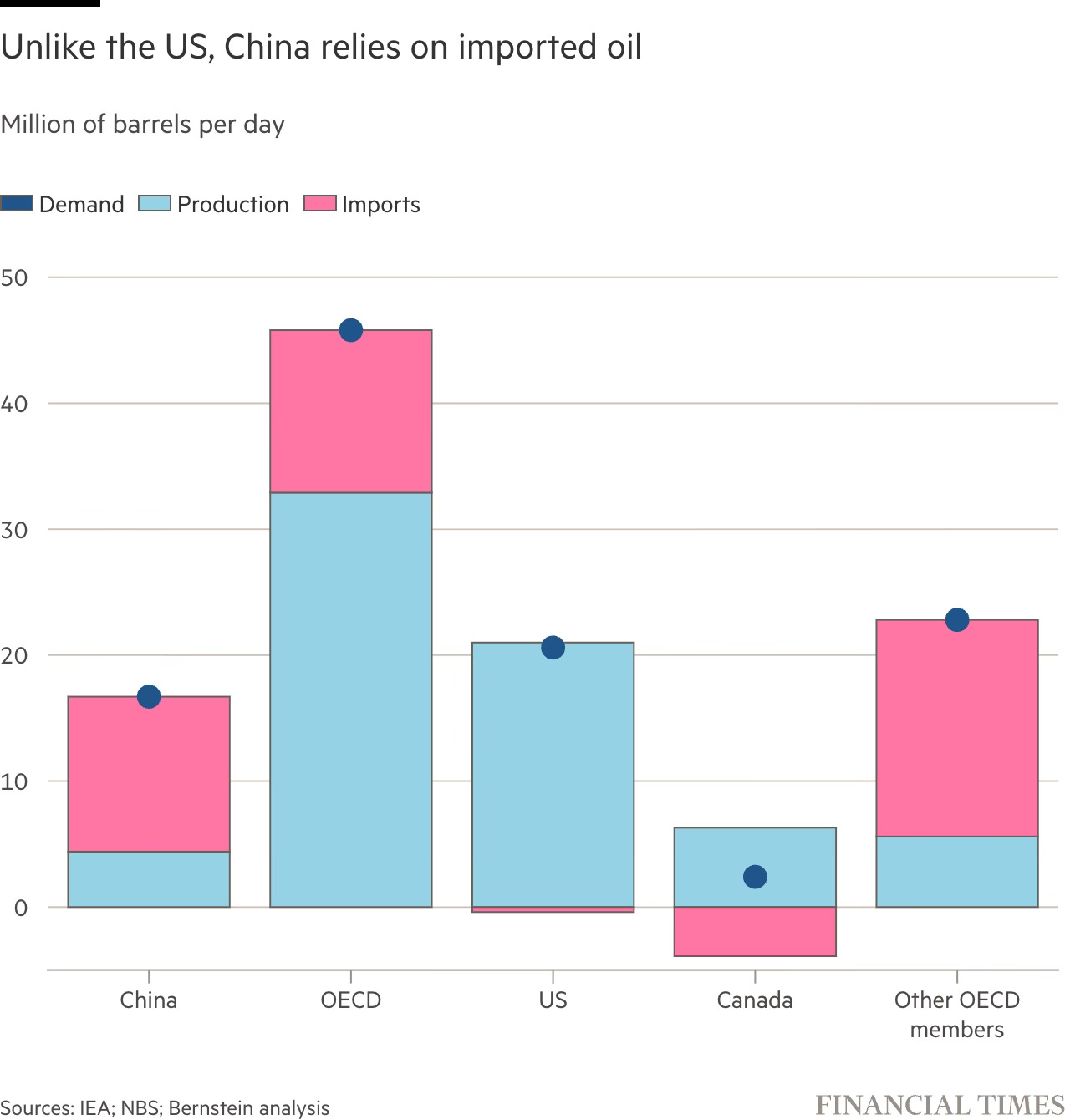
China consumes roughly 17 million barrels of oil per day but produces only about 4 million domestically. The remaining supply must be imported, much of it from the Persian Gulf. These shipments travel through vulnerable maritime corridors such as the Strait of Hormuz. Any disruption in that region therefore carries direct consequences for China’s energy supply.
The contrast with North America is striking. The US now produces roughly as much oil as it consumes, while Canada exports a surplus. For China the issue is not simply higher oil prices during geopolitical crises. It is the structural reality that its economic engine depends on supply routes shaped by conflicts and tensions far beyond its borders.
Source: Financial Times
The recent tensions involving Iran have reminded markets of a simple but uncomfortable truth. Much of the global economy runs on oil that must pass through a handful of narrow waterways. When instability appears near those routes, the vulnerability of the system becomes impossible to ignore.
I have four more charts that explore this theme further and show how energy, geopolitics and trade are reshaping the global economy. They are part of the paid edition. Consider subscribing if you want the full analysis and the rest of this week’s Five Killer Charts.
