

For $10 a month, or $100 a year, you support a simple mission: spread great data visualisation wherever it comes from. You help fund the work of finding, sourcing and explaining the charts that deserve a wider audience. And you back a publication built on generosity, transparency and the belief that better understanding makes a better world.CHART 1 • China’s energy transition is happening on top of coal
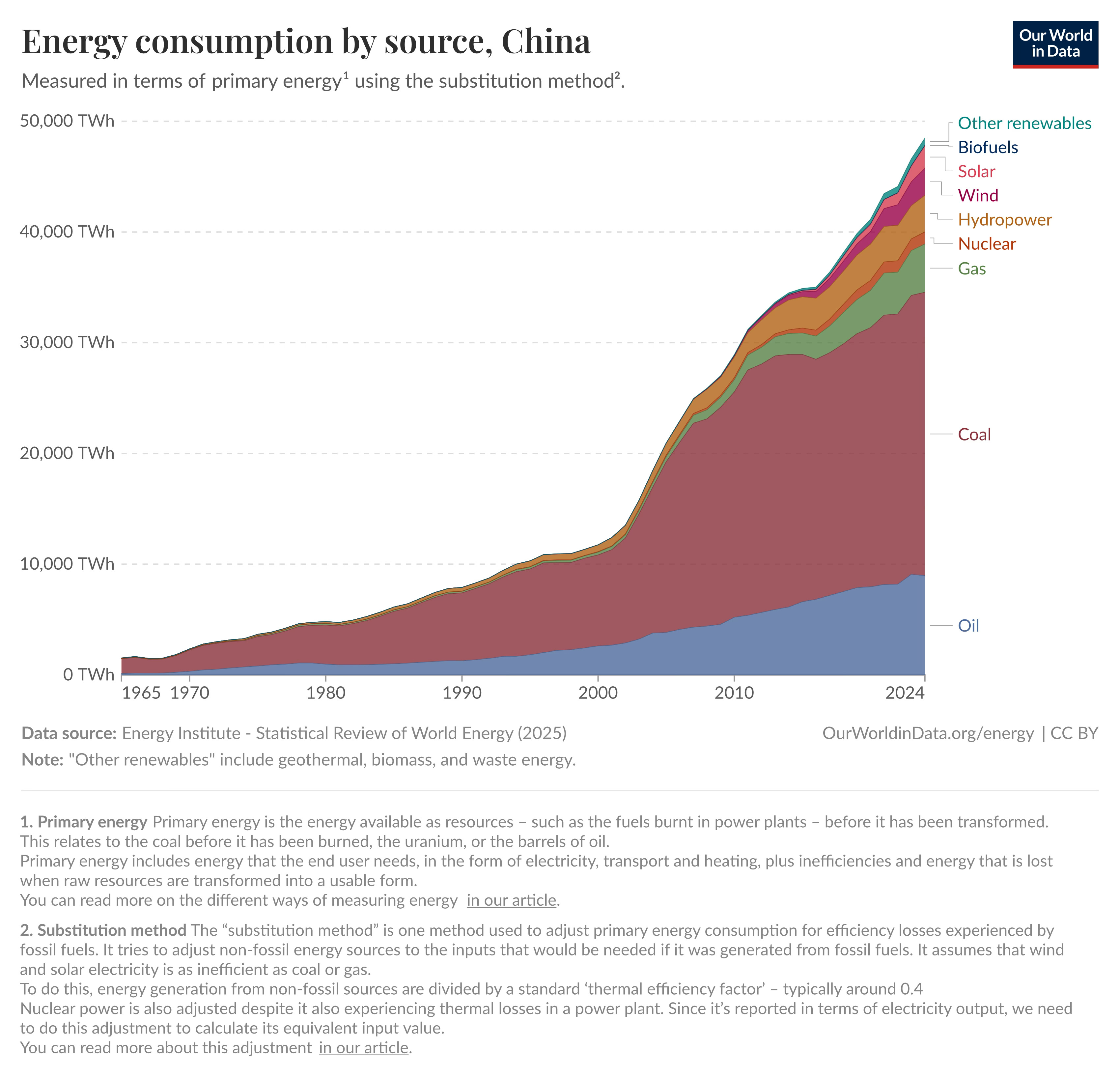
China’s energy story is often told as a pivot away from fossil fuels. This chart shows something more complicated and more revealing.
Total energy consumption has exploded over the past three decades rising from a modest base in the 1980s to close to 50,000 terawatt hours today. Almost all of that surge was initially met by coal. Even now coal remains the single largest source of energy in China by a wide margin. In absolute terms coal use is still rising not falling.
What has changed is what gets layered on top. Oil demand has climbed steadily with transport and industrial growth. Gas has expanded from almost nothing into a meaningful contributor. Nuclear has grown slowly but consistently. And in the past decade renewables have moved from the margins to the fastest growing part of the stack. Solar and wind in particular have accelerated sharply since the late 2010s.
The key point is scale. China is not replacing coal with clean energy. It is adding clean energy alongside coal to support an economy that is still growing and electrifying at extraordinary speed. Even record additions of solar and wind struggle to outweigh the sheer momentum of total demand.
This helps explain why global emissions outcomes hinge so heavily on China. The transition is happening but it is being swamped by growth. Until overall energy demand flattens renewables mostly slow the rate at which fossil fuel dependence rises rather than reversing it outright.
The chart is less a story of failure than one of arithmetic. China is building the energy system of the future at unprecedented speed but it is doing so while still running the energy system of the past at full throttle.
Source: Our World In Data
What struck me most in this set is how stubborn energy reality remains. We talk about ambition, targets and tipping points, yet the charts keep pulling us back to scale, inertia and arithmetic. Transitions are not about intentions. They are about what societies can actually afford to switch off.
There is also something human in this. We rarely abandon systems that work. We add, adapt and compromise instead. Energy transitions mirror how people change their lives, slowly, unevenly and with old habits still humming in the background.
I have four more charts that dig deeper into this story of power, constraint and transition, but they are for paid subscribers. Consider joining if you want the full edition and a clearer view of where the energy world is really heading.
