


For $10 a month, or $100 a year, you support a simple mission: spread great data visualisation wherever it comes from. You help fund the work of finding, sourcing and explaining the charts that deserve a wider audience. And you back a publication built on generosity, transparency and the belief that better understanding makes a better world.CHART 1 • Britain’s huge decline in maternal mortality
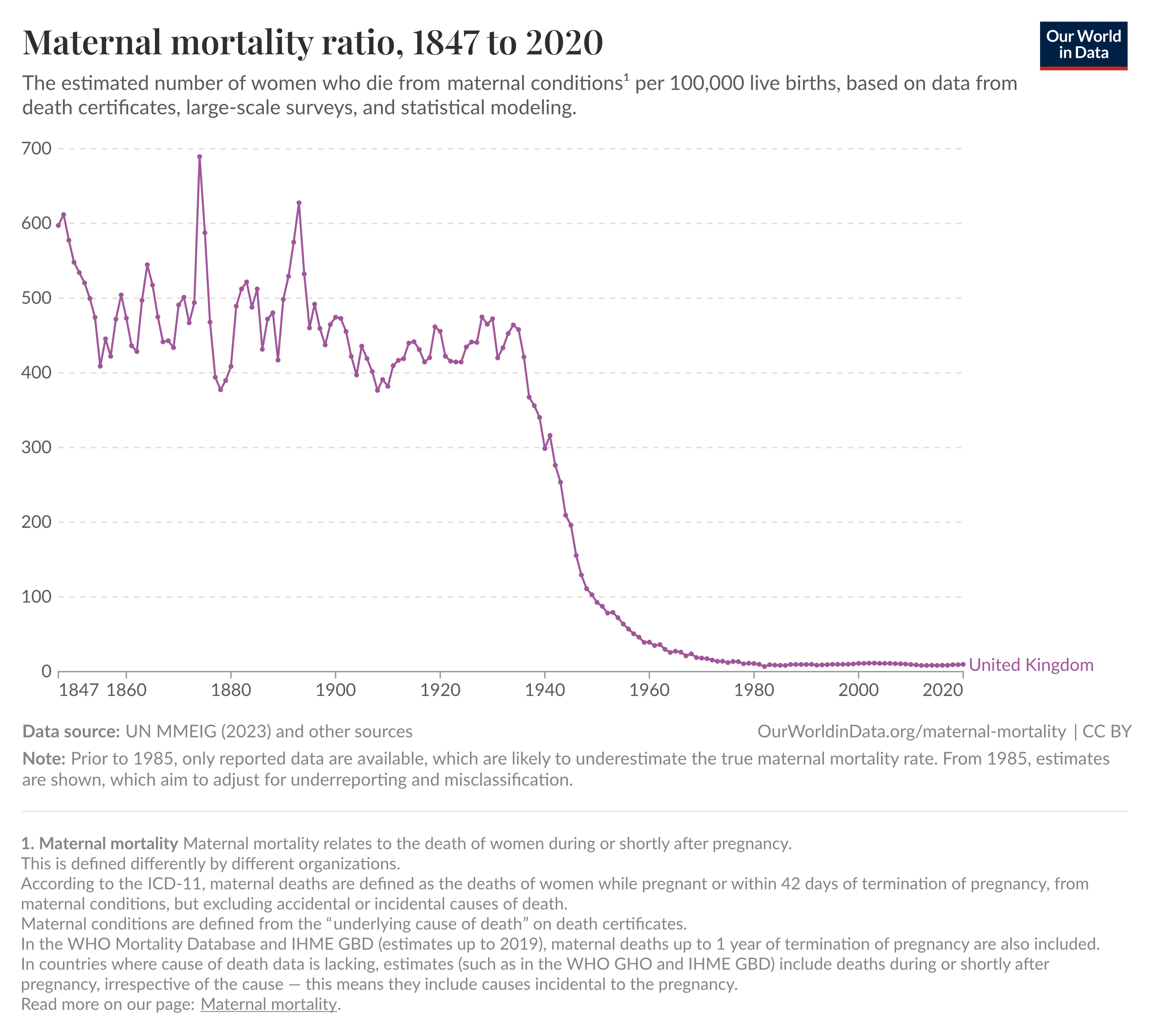
It is easy to forget how dangerous childbirth once was. This chart shows a transformation so dramatic that it almost fades into the background of history.
In the late 1800s, more than 400 women died for every 100,000 live births in the UK. At times, the figure spiked far higher. Progress was slow for decades. Then, around the 1930s and 1940s, the line collapses. Maternal mortality falls not gradually, but sharply, dropping below 100 and then into single digits within a generation.
The reasons were structural rather than incremental. Clean water, antiseptics, antibiotics, safer surgery and the professionalisation of midwifery changed the risk profile of childbirth entirely. Hospitals became places of care rather than danger. This was not driven by one breakthrough, but by systems working together. Public health, medical science and state capacity reinforced each other.
What stands out is how permanent the change has been. Since the 1960s, maternal mortality in the UK has remained extremely low by historical standards. There have been fluctuations, but nothing remotely comparable to the risks women faced just a century ago. It is a reminder that some of the biggest gains in human welfare come from boring, cumulative improvements rather than dramatic innovation.
If progress like this was possible once, why does it feel so hard to achieve similar breakthroughs in health outcomes today?
Source: Our World In Data
What stayed with me this today is how uneven progress really is. We can eliminate centuries old risks in one area, yet struggle to agree on basic facts in another. We can build systems that save lives reliably, but allow trust, skills and cohesion to erode at the same time.
I have four more charts that deepen this story and explore where long term progress is still being made, and where it is quietly slipping. They are for paid subscribers. Consider joining if you want the full edition and a clearer view of what really shapes outcomes over time.
