


For $10 a month, or $100 a year, you support a simple mission: spread great data visualisation wherever it comes from. You help fund the work of finding, sourcing and explaining the charts that deserve a wider audience. And you back a publication built on generosity, transparency and the belief that better understanding makes a better world.
CHART 1 • Brexit may have cut UK GDP by 2% to 4%
Brexit did not need to produce an instant disaster to be expensive. The more damaging version is slower: a persistent gap between the economy Britain has and the one it might have had.
Bloomberg Economics puts that gap at 2% to 4% of GDP. The mechanism is not mysterious: weaker trade intensity, lower investment, management distraction, labour constraints and less productive integration with nearby markets.
No counterfactual deserves blind faith. Britain has faced other shocks, and models vary. But a few percentage points of GDP is not a rounding error. It is fiscal room, wage growth and public patience lost in small increments.
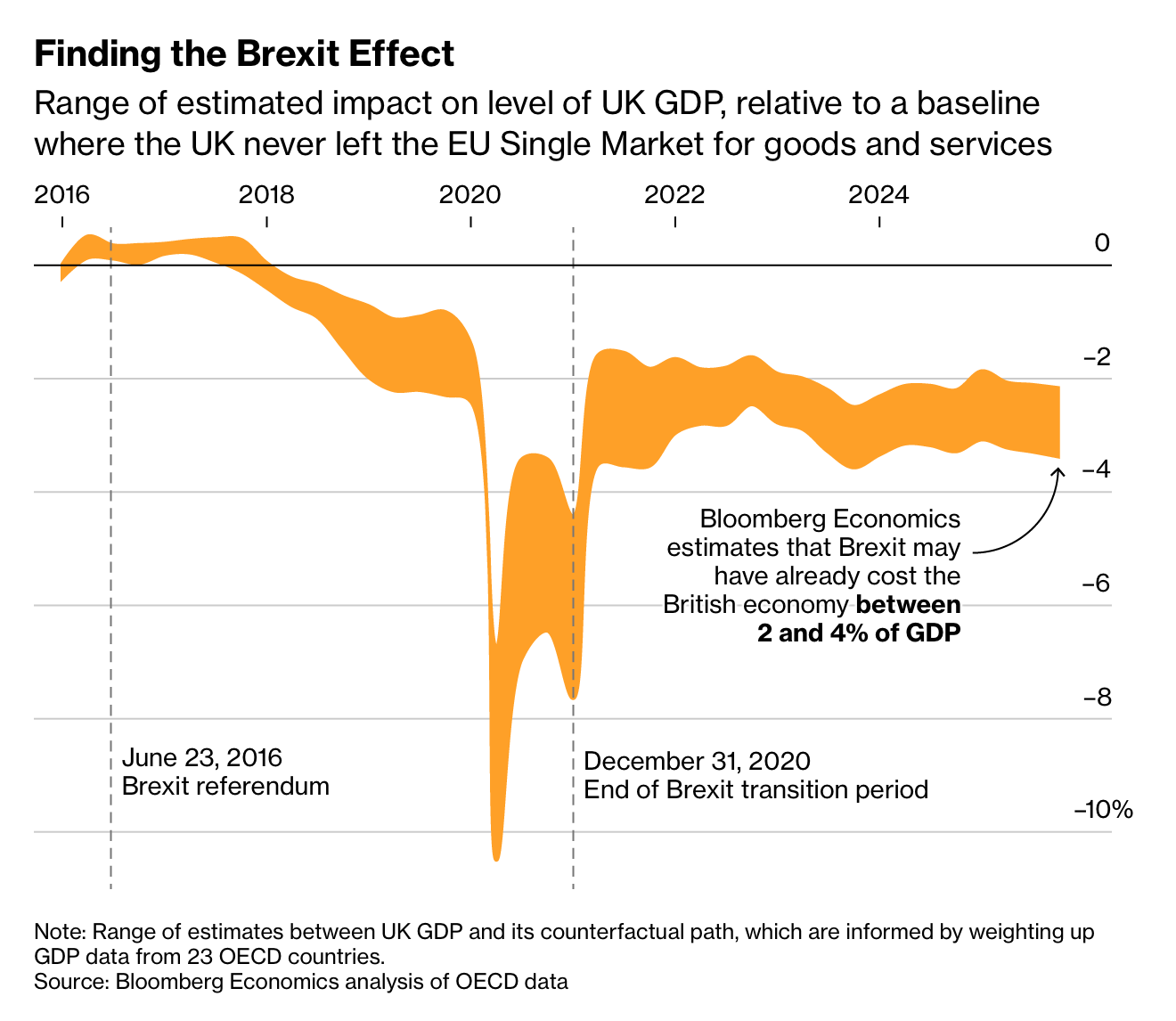
Source: Bloomberg
Britain’s problem is not that nothing works. Some parts still work rather well. London finance keeps adding jobs, elite universities can still charge global prices, and airlines are again investing for growth.
The harder question is whether those strengths add up to a national strategy, or whether they are isolated islands inside a slower economy. The remaining charts follow that tension without pretending it has a neat answer.
