


For $10 a month, or $100 a year, you support a simple mission: spread great data visualisation wherever it comes from. You help fund the work of finding, sourcing and explaining the charts that deserve a wider audience. And you back a publication built on generosity, transparency and the belief that better understanding makes a better world.CHART 1 • America builds more data centres than the rest of the world
America’s dominance in data centres is not just a sign of digital strength. It is a huge wager on what AI will require. The US accounts for 4,088 of the world’s 9,493 listed facilities, or about 43% of the total. That suggests American firms are betting that the next phase of computing will still depend on vast, centralised infrastructure rather than a fully local, device based future.
That bet may look obvious today, but it is not without risk. If models become smaller, cheaper and more efficient, more useful AI could run on phones, laptops and other personal devices. In that world, some of today’s construction boom may come to look excessive. But the cloud is unlikely to disappear. Training, storage and large scale enterprise workloads still favour enormous remote systems.
That is what makes the US lead so important. The International Energy Agency expects global data centre electricity demand to reach around 945 terawatt hours by 2030, with the United States accounting for by far the largest share of the increase. So even if the AI boom cools, America is still locking in the power and capacity behind it. The bigger risk may be less that the US has built too much, and more that others have built too little.
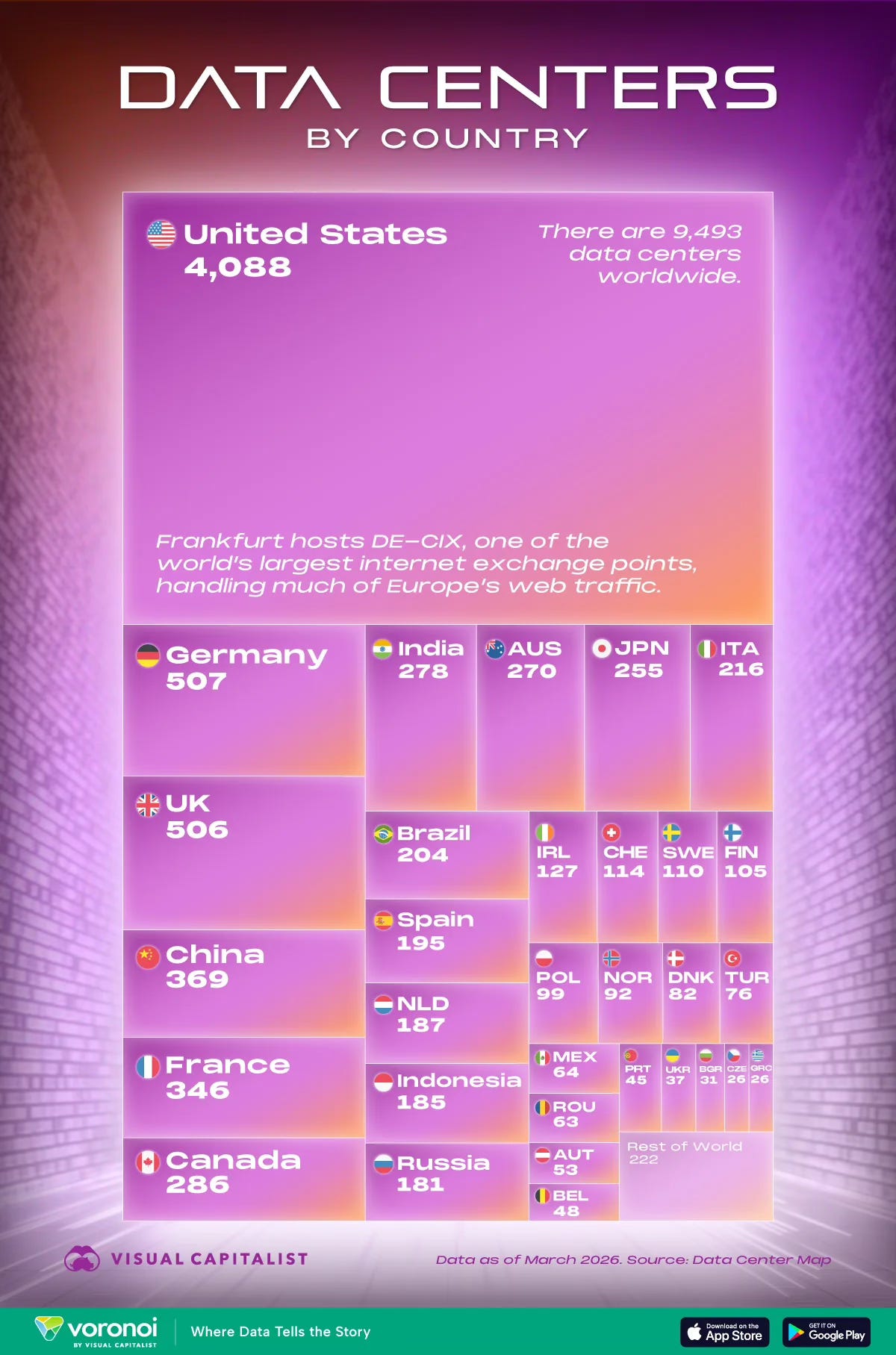
Source: Visual Capitalist
We spent years talking as if digital growth would float above the old constraints of industry. Instead, we are back to the hard stuff: electricity, networks, capital allocation and the awkward reality that even the smartest technologies still depend on physical systems that can break, clog up or be misjudged.
There is something humbling in that. Progress is real, but it is never as frictionless as the sales pitch suggests. Every boom eventually runs into the limits of the world as it is, not the world people imagined in a slide deck.
I’ve got four more charts that expand on this story, but they are for paid subscribers. Consider joining if you want the full edition.
