

The world feels as if it is shifting under our feet. You can see it in the places we borrow from, the places we study in, the rivers that shaped us, the companies that survived disruption and the leaders now walking away from the top job. Here we have five charts, and five different stories. Yet all pointing to the same idea. The old anchors of stability are not as firm as they once were.
That’s what today’s charts are about.
Quick note — Killer Charts has been $8/month and $80/year since launch two years ago. From 1 December the price for new subscribers will rise to $10/month and $100/year. If you’ve been meaning to upgrade, you can lock in the old rate for life here.CHART 1 • Advanced economies carry far more debt than emerging markets
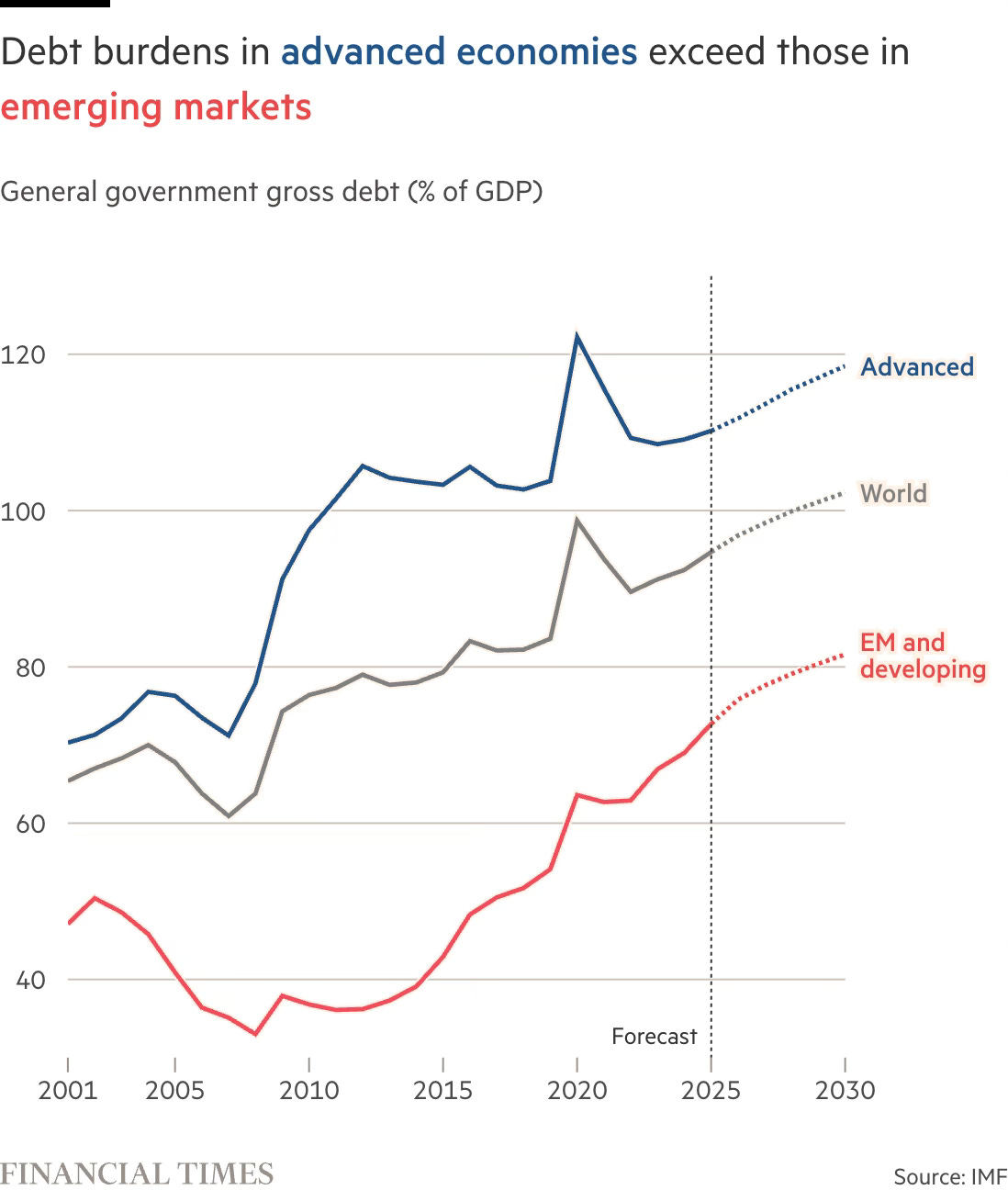
It is easy to assume that the world’s debt problem sits in emerging markets, yet the data tells a very different story. Advanced economies now shoulder far larger debt burdens, and the gap is set to widen further over the next few years. That matters because it changes who is truly vulnerable when growth slows or markets tighten.
This chart shows how government debt in advanced economies has climbed from roughly 70% of GDP in the early 2000s to well over 110% today, with forecasts pointing higher. Emerging markets start from a much lower base. Their debt has risen sharply since 2010, but it still sits far below the levels seen in richer countries. The global average has been pulled up largely by the advanced world, not the developing one.
The historical context is important. After the financial crisis and the pandemic, wealthier nations had the fiscal room to borrow heavily. They issued large rescue packages, absorbed private sector losses and stabilised their economies. Emerging markets did not have that luxury. Their lower debt levels are not a sign of stronger fundamentals. They simply lacked the capacity to borrow at scale.
But with ageing populations, slowing productivity and rising interest costs, the question now shifts. If debt in advanced economies keeps climbing, how long can this model hold before it begins to constrain growth?
Source: Financial Times
What unsettles me in all of this is how much of our economic confidence rests on assumptions that no longer hold. High income countries with rising debt. Boardrooms under stress. Talent flows shifting. Natural advantages determining more than we care to admit. The patterns feel familiar yet also strangely fragile.
I have got four more charts that expand on this story, but they are for paid subscribers. Consider joining if you want the full edition.
